The history of Croagh Patrick is usually told through Saint Patrick, ancient traditions and the thousands of pilgrims who climb its slopes. But the mountain also has a more personal history, preserved in family memories, working lives and acts of hospitality.
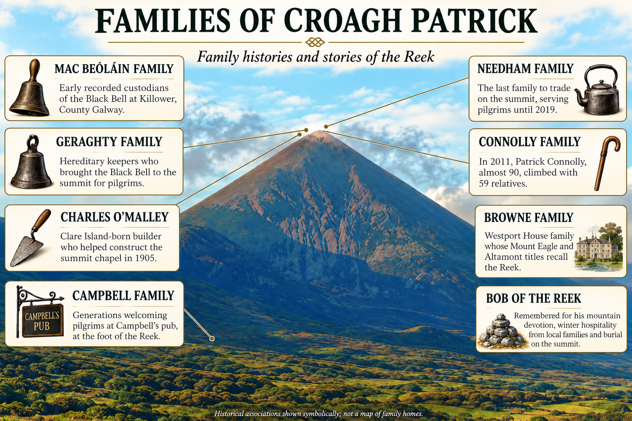
Families of Croagh Patrick: Bell Keepers, Builders and Generations Beneath the Reek
Croagh Patrick’s history is usually told through Saint Patrick and the pilgrims who follow in his footsteps. Alongside that familiar story is another: the families whose lives became entwined with the mountain.
They kept its sacred bell, carried supplies to its summit, built its chapel and welcomed pilgrims into their homes and businesses. Some held great estates beneath its slopes. Others left their mark through work, hospitality and stories passed down through generations.
The Mac Beóláins: Early Keepers of the Black Bell
One of the oldest recorded family connections concerns the Mac Beóláins of Killower, County Galway, custodians of the Black Bell of Saint Patrick.
Material reproduced by Galway County Heritage Office from the Ordnance Survey Letters identifies Mac Beóláin of Kill-leabbair as the herenach of Patrick’s Clog Dubh. The reference places the bell’s care within a system of hereditary religious responsibilities and associated lands.
A nineteenth-century discussion of church bells also names Mac Beolan of Killower as its keeper and connects the object with the bell brought to Croagh Patrick. The mountain’s religious associations therefore extended beyond Mayo into households and communities in Galway.
Later accounts identify the Geraghtys as its custodians. The evidence connects both families with the bell, although the circumstances in which responsibility passed between them remain unclear.
The Geraghtys: A Sacred Relic on the Summit
The Geraghty family, associated in nineteenth-century accounts with the Ballinrobe area, brought the Black Bell to Croagh Patrick during the annual pilgrimage.
Pilgrims paid a penny to kiss it. Those seeking relief from rheumatism could pay twopence for a ritual in which it was passed around their bodies. Such practices reflected the healing and protective powers people attributed to sacred objects.
Legend explained the bell’s dark appearance by claiming that Patrick had used it against the demons tormenting him on the mountain. That story belongs to religious folklore. The surviving bell is generally dated to the early medieval period, later than Patrick’s lifetime.
For its keepers, custodianship involved more than possessing an old object: the family maintained a connection between the relic and the pilgrims who came to venerate it.
The bell eventually passed through antiquarian Sir William Wilde into the collection now held by the National Museum of Ireland. Accounts differ over the details of its sale, but the Geraghtys’ role as hereditary keepers is recognised in scholarship on Patrick’s relics.
The Campbells: Hospitality at the Mountain’s Gateway
At the foot of the main Murrisk ascent, Campbell’s pub became a familiar starting and finishing point for generations of pilgrims.
The premises have a long history. The National Inventory of Architectural Heritage records the former Croaghpatrick Hotel as reconstructed for Owen Campbell, born in 1842, adjoining an eighteenth-century farmhouse dated to 1740. The age of the building should be distinguished from the length of the family’s ownership.
A later Owen Campbell, affectionately remembered as Owenie, took over the business at fifteen following his father’s death. Born in 1934, he spent approximately sixty years welcoming those who came to climb the Reek.
His obituary recalls a publican who offered pilgrims water, advice about weather and routes, and encouragement before their ascent. He welcomed archaeologists researching the mountain and supported the campaign against proposals to mine it for gold. He died in September 2009.
A local tradition also holds that the Campbells were related to a former Archbishop of Tuam. The Archbishop’s identity and the precise relationship have yet to be established, so this remains a family-history lead rather than a confirmed genealogical fact.
Bob of the Reek: A Hermit Supported by His Neighbours
The story of Bob of the Reek brings the mountain’s history into the homes of the surrounding community.
Historical accounts describe a man who undertook the pilgrimage on behalf of people unable to make it themselves. A scholarly history of Irish pilgrimage records that neighbours welcomed him during winter and later honoured his wish to be buried on Croagh Patrick. Local tradition places his winter stays with families around Lecanvey.
His name varies between accounts. Published versions call him Robert Binn or Benn, while a story in the Lecanvey Schools’ Collection names him Bob Geraty, living at Gloshpatrick. These differences are part of the surviving record.
The Lecanvey account was supplied by Myles Hynes, who had helped carry materials for the summit chapel. It describes Bob cultivating potatoes and frequently climbing the mountain.
Before his death, Bob reportedly paid Thomas O’Malley, a Murrisk publican, for a barrel of porter to reward those who would carry his coffin uphill. The account identifies Thomas as the grandfather of the Owen Campbell living when the story was collected.
Neighbours carried Bob’s remains to the summit. According to the same tradition, his burial lay on the site of the later chapel, and bones uncovered during its construction were reburied at the eastern end. The attribution of those bones to Bob belongs to the oral account; it is not an independently established identification.
The story remembers both an unusual pilgrim and the neighbours who helped sustain his way of life.
The Needhams: Serving Pilgrims on the Summit
For generations, local trading families brought refreshments onto Croagh Patrick, carrying supplies uphill and using donkeys to transport their loads.
Their temporary stalls were part of the pilgrimage experience. A welcome cup of tea depended on preparations below, a demanding ascent and the ability to work in exposed conditions.
According to Louisburgh–Killeen Heritage, the Needhams were the last family to trade on the summit, in 2019. Their final season brought a longstanding mountain livelihood to an end.
The heritage group’s Traders on the Reek project preserves memories of these families. In 2024, the Needhams supplied equipment and three donkeys for a filmed reconstruction. Members of the Walsh family also participated in recreating the preparations, the climb, the erection of a stall and the making of tea.
Their work forms an important chapter in the economic and social history of the villages beneath the mountain.
Charles O’Malley: Building the Chapel Above Clew Bay
Charles O’Malley, born in Lecarrow on Clare Island, was among the men who helped construct the summit chapel.
The O’Malley Clan Association records that his parents were John and Honoria O’Malley and that he learned his trade in Louisburgh. He married Bridget O’Grady, also from Clare Island, in 1912. They settled on the North Mall in Westport and had eight children. Charles later became chieftain of the O’Malley Clan Association in 1959.
A newspaper account published in 1940, drawing on his recollections, describes the chapel’s construction in 1905.
Fifteen men worked on the building. Cement travelled uphill on donkeys or on the workers’ backs, while water for concrete had to be fetched from far down the western slope. Steel roof supports were brought up in sections.
For nearly three months, Charles and the contractor, identified as H. Heneghan of Louisburgh, stayed overnight on the summit during the working week. Their shelter was a small wooden hut covered with felt. During storms, they weighted it with stones and took turns keeping watch.
The work took approximately four months and was reportedly completed without accident.
Although the clan biography gives a different date, the detailed account based on Charles’s recollections identifies 1905.
The O’Malleys and Brownes: Coastal Power, Marriage and Inheritance
The wider O’Malley family belongs to the maritime history of Clew Bay. Gráinne O’Malley, the sixteenth-century sea captain, emerged from this coastal world of ships, strongholds and competing territorial interests.
The family’s legacy also connects with Westport House, whose site is associated with an earlier O’Malley stronghold. In 1669, Colonel John Browne married Maud Bourke, Gráinne’s great-great-granddaughter. Through that marriage, the Brownes of Westport became descendants of the famous maritime leader.
The Brownes’ connection with Croagh Patrick appears explicitly in their titles. John Browne became Baron Mount Eagle in 1760 and Earl of Altamont in 1771. Both names derive from the mountain, with Mount Eagle recalling its older name, Cruachán Aigle. The family later became the Marquesses of Sligo.
These are connections through landscape, ancestry and estate history. They sit alongside the very different associations of families who earned their living by serving pilgrims or working on the summit.
The Connollys: A Family Returns to Its Mayo Roots
On 3 August 2011, two days before his ninetieth birthday, New Yorker Patrick Connolly climbed Croagh Patrick with fifty-nine relatives.
His father had emigrated from Mayo. Patrick intended the climb as an act of thanksgiving for his family’s Irish roots and in honour of his and his wife Breeda’s parents.
An interview in Irish America describes his preparation through walking and gym sessions. He had a pacemaker and obtained his doctor’s approval before undertaking the climb.
The family travelled slowly, stopping frequently. Beside Patrick throughout the reported fifteen-hour journey was his seven-year-old great-grandson, also named Patrick. Approximately eighty relatives took part in the wider gathering, including those who remained below.
For this family, the mountain became a place where generations met and remembered the people whose departures from Ireland had shaped their lives.
The Stories Still to Be Recorded
There is more to discover about the households around Croagh Patrick: their working lives, school journeys, trading routes and connections across the mountain.
Memories of children crossing the shoulder to school deserve particular attention. Identifying the families, their homes, the school and the route would allow those recollections to become a properly documented part of this history.
Does your family have a connection with the Reek? Do you remember the summit traders, stories about Bob’s winter stays, the Campbells’ Archbishop connection, or children travelling across the mountain to school? Photographs, letters and firsthand memories could help preserve the next chapter.
Please contact [email protected] if you have a connection or something to share.
References
Croagh Patrick and the Islands of Clew Bay
Related Posts
- When Pilgrims Climbed Croagh Patrick Through the Night
- The Path up Ireland’s Holy Mountain
- Croagh Patrick and Other Sacred Summits
- The History and Mystery of Croagh Patrick
- The Search for Gold on Croagh Patrick
- Stories from the foot of Croagh Patrick
- Sherpas on the Reek
- Croagh Patrick and the Rolling Sun