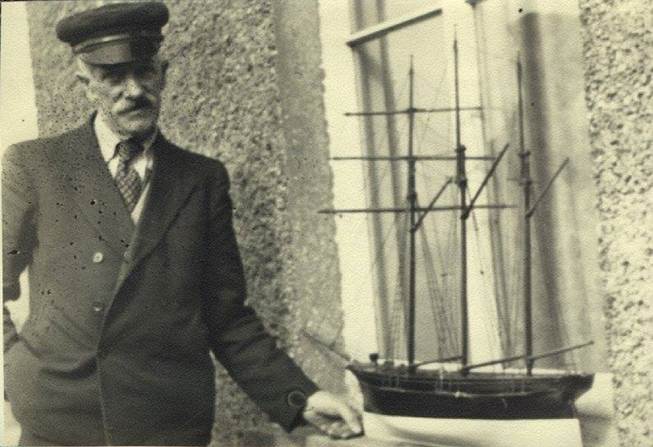
Pilot Peter Hopkins of Rosbeg around 1964
Before the Westport Harbour legislation of 1853, the story of pilotage in Clew Bay began with a race. An incoming ship meant a chance to earn money, and boatmen went out to meet her. In the outer bay, Achill men competed to reach merchant vessels first. The prize was the work of guiding a stranger through waters they knew better than almost anyone aboard.
It was a race for a living. A captain approaching from the Atlantic needed to know where he could take his ship, how much water lay beneath her and what the tide would allow. The man coming alongside in a small boat could provide that knowledge. Getting to the ship first mattered; getting her safely through the dangerous shoals and hidden rocks of Clew Bay mattered more.
Local historian John Mulloy later described those competing outer-bay pilots and a different arrangement farther in, where men took turns guiding ships towards Westport. The precise moment when one practice gave way to another is less clear than the memory of the boats racing. What changed in 1853 was that Westport’s Harbour legislation placed the appointment and licensing of pilots firmly in the hands of the Harbour Commissioners.
Behind the race lay a busy port. Beyond that port lay a town and countryside waiting for what the ships carried. A safe arrival meant goods for merchants, work for labourers and earnings for the families who lived around the bay. Hopkins, Gibbons, Gill, Kelly and Jeffers were among the names associated with the men who made those arrivals possible.
A town looking out to sea
Westport’s former warehouses tell us something that is easy to forget when looking at the Quay today. They were built to hold cargo. Their size belongs to a time when the town looked seawards for much of its business, and when an arriving vessel was an event with consequences well beyond the waterfront.
For a time in the nineteenth century, Westport became an important commercial centre in the west of Ireland. Ships connected it with Liverpool and Glasgow, carrying people, livestock and goods. Timber, grain and coal came into the port; livestock and eggs were among the cargoes sent out. Flour and other merchandise passed through the sheds and warehouses. Carts carried goods between the waterfront and the town, while traders supplied customers across the surrounding countryside.
The pilot stood near the beginning of that movement. Before a warehouse could receive a cargo, before a merchant could sell it and before a labourer could unload it, the vessel had to arrive safely. The last miles of her voyage might be among the most demanding. Clew Bay offered shelter, but its islands, shoals and tidal channels made local knowledge valuable. A stretch of water that looked inviting could be too shallow for the ship entering it.
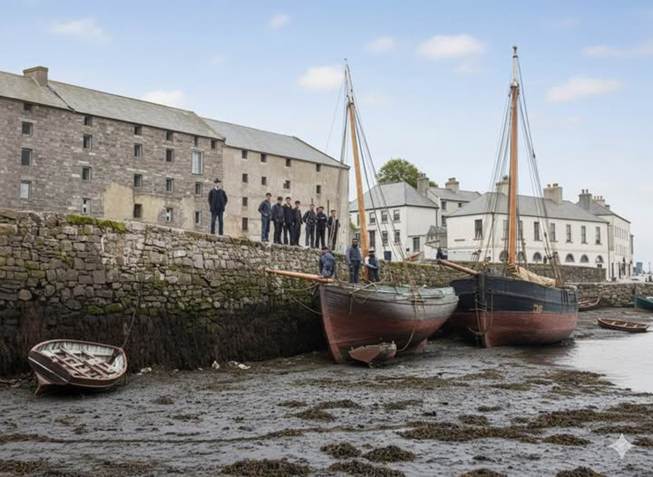
Westport Quay around 1890
The pilot had to think about the particular vessel under his care. What was her draught? Where could she turn? Would there be sufficient water when she reached the inner harbour? His knowledge was practical and specific, built around the difference between what a ship’s master could see and what the local man knew lay beneath the surface.
At the Quay, other men waited for the result. Across from the Custom House stood the Idle Wall, where labourers gathered in the hope of being called to load or unload a boat. Liamy MacNally’s recollection describes the men meeting and talking there, with a hut nearby offering shelter when it rained. The wall’s name concealed the uncertainty of their situation: they were waiting because the work depended on ships arriving and hands being required.
That dependence connected the man at the Idle Wall with the pilot out in the bay. One watched for employment from the shore; the other went out to bring it in. A ship might provide work at several stages, from her first approach to the handling of the last of her cargo.
The railway added another link. Westport gained its main railway connection in 1866, and by the mid-1870s a branch reached the Quay. Goods could move between ship, warehouse and railway wagon, and onwards beyond the immediate district. The railway made the waterfront part of a wider transport network. Its track ran through a town already shaped by maritime trade, joining the harbour to the routes inland.
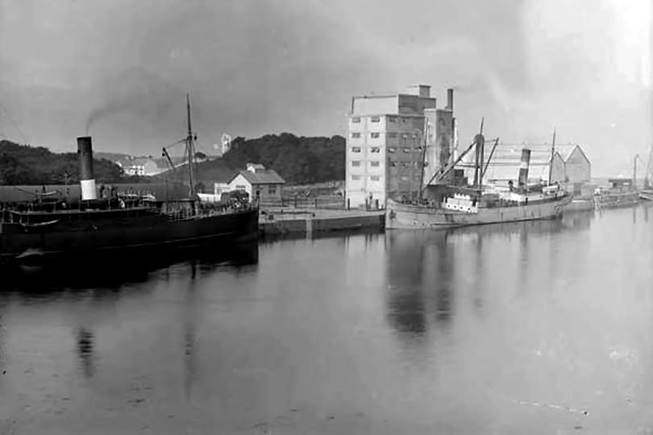
Westport Quay showing the now demolished Mill
For a time, the Quay gathered these different kinds of work into one place. There were sailors and pilots, dock labourers and carters, merchants and railwaymen. The arrival of a ship set more than one household’s working day in motion.
The ships that stopped at Inishlyre
Some of the largest vessels serving Westport could never complete the journey to its quay with their cargo aboard. They needed deeper water. For them, the anchorage at Inishlyre was a vital part of the port.
The island was small, but its importance was out of proportion to its size. It stood between the ocean-going ship and the shallow inner harbour. A vessel could anchor there while smaller craft came out to take her cargo onwards. These were the lighters: working boats whose shallower draught allowed them to carry goods into water the larger ship could not safely enter.
The cargo’s voyage continued in stages. First came the passage from the ship into the lighter. Then came the journey through the inner bay, followed by another unloading at the Quay. The great vessel and the small boat belonged to the same business. Without the smaller craft and the men who worked them, a deep anchorage alone could not supply Westport’s warehouses.
Achill boatmen were part of this trade, using hookers as lighters. The work required its own judgement. Cargo had to be carried in boats small enough for the route but capable of making the journey safely. Wind and tide still governed the passage, even though the ocean crossing was over.
Pilots and lightermen did different jobs. The pilot guided the ship; the lighterman carried her goods. Yet they worked within the same network of maritime families, and their livelihoods met around the anchored vessels. A man might also farm, fish or own a trading boat. Around Clew Bay, the sea provided several kinds of employment, and households often depended on more than one.
Inishlyre was consequently a place of arrivals and departures, of cargo and conversation. In 1851 it had 122 inhabitants living in seventeen houses. Accounts remember two pubs and a hotel, reminders that it served people passing through as well as those who belonged there. Westport’s first lifeboat station was established on the island in 1857. Its position made sense: help was needed near the approaches and anchorages where ships encountered danger.
The Gibbons name became closely associated with Inishlyre. In the 1911 census notes, Thomas Gibbons, aged thirty-nine, and William Gibbons, aged thirty-eight, appear among its pilots. Their presence places the occupation within the small island community at the centre of the shipping trade.
William would later become the named pilot in a court case that exposed how the service worked.
The Hopkins household at Rosbeg
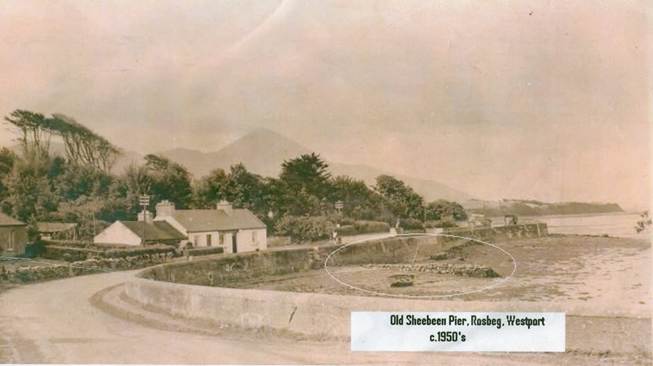
The Sheebeen around 1950, showing the pier maintained by the Hopkins pilots which moored the boat used to row out to Inishgort Lighthouse
Across the water, at Rosbeg, the Hopkins family combined pilotage with boats, trade and the public house remembered as the Sheebeen. Their story reaches back beyond the generations whose work can be followed clearly.
Family accounts identify an Aughavale tomb commemorating Patrick Hopkins, born in 1706 and dead in 1802. How that early Patrick connects with the later pilots remains unresolved. Paddy Hopkins, the eldest son of the pilot Peter Hopkins, began his own recollection with Hubert Hopkins of Rosbeg. Hubert married Mary Kelly of Islandmore, whose father, Dan Kelly, was remembered as having moved there from Dorinish Mór – later owned by the Beatle John Lennon – after an eviction.
That marriage joined a shore household to an island family. Paddy named five children: Honoria, Sarah, Ellen, Hubert and Patrick. It was Patrick who married Mary McNamee and became the shipowner and pilot remembered by the succeeding generations. A Peter Hopkins also appears as Head of Household at Rosbeg in Griffith’s Valuation in the 1850s, and he was likely to have been Hubert’s older brother as the tradition was to name the eldest son after the father.
Patrick Hopkins senior was born about 1829 and lived until 1911. The family referred to him as an Admiralty pilot, a title that survives in their recollections. His occupation is firmly recorded in a much more ordinary document: the registration of his son Peter’s birth at Rosbeg on 17 May 1884. Beside the father’s name, the registrar wrote “Pilot.” Mary McNamee was the child’s mother.
Patrick’s work extended beyond meeting merchant ships. On 22 June 1874, the Mayo Examiner carried a notice offering excursions around Westport and neighbouring bays aboard his cutter yacht Spirit. The forty-ton vessel had previously belonged to the late Rev. Samuel Jervois of Connemara. Hopkins would sail her himself. His seamanship, useful to a captain entering unfamiliar water, could also reassure passengers setting out for pleasure.
Paddy Hopkins family history remembered four vessels: Margaret Leonard, Kate, Spirit and Helen. The names suggest the range of the family’s maritime interests, although they should not all be imagined as dedicated pilot boats. A shipowner could earn money from trading and carrying passengers as well as from the work for which he held a pilot’s licence.
There was loss in the family story too. Spirit was remembered as having been wrecked near Carrowmore Point on Clare Island in 1886, with overloading given as the explanation in Paddy’s account. Paddy’s sister Gerardine recalled that Patrick Hopkins brother had agreed to carry a large shipment of herrings from Clare Island to Westport Quay the previous night.
At Rosbeg, the public house known as The Sheebeen provided another source of income. One account says Patrick bought it from his sister Honoria. The memories differ over who held the licence at different times, naming Mary McNamee in one version and Pat Kelly of Islandmore in another. Whatever the sequence of licences, the house became an important setting for the family’s life.
Two of Patrick and Mary’s sons followed him into pilotage. The younger Patrick, born about 1870 or 1871, appears as a pilot in the 1901 and 1911 census notes. He died in 1925, three months after an unsuccessful operation to treat an umbilical hernia. His brother Peter was born in 1884. This was a household in which a father’s occupation continued into the next generation, alongside the wider business of boats and the pub.
Peter’s children were Gerardine, Paddy, Kathleen, Florence, Peter, Ceura, Vincent, Joe and Eithne; the spelling Ceura is retained from the family account. The first six were remembered as having been born at the Sheebeen. For these children, pilotage was their father’s work, with all the absences and uncertainty that work at sea could bring.
Gerardine recalled that bad weather sometimes prevented Peter from returning home and obliged him to stay with island families. Such visits depended on connections that ran across the bay. A pilot needed a boat and knowledge of the channels, but it helped to have a household ashore where he could find shelter when the weather closed in.
The sea could also reach the family at home. During the flooding at Rosbeg in November 1926, Peter watched the tide and closed the sluice gates, only for the water to return unexpectedly. Linda Cusack’s later account in the Irish Times remembers the piano being raised on beer barrels and sheet music subsequently appearing along the shore. The family temporarily stayed with the Shanleys at Rosmalley. It is a domestic memory of the same forces that shaped a pilot’s working life. Paddy Hopkins recalled that the sea had ‘come under the wall’ and into the house that night.
The family reportedly sold the pub in 1927. Peter lived until around 1967, carrying the occupation into an era when the bay’s commercial life was changing around him.
A licence and a share of the earnings
The Harbour Act of 1853 gave the Westport commissioners power to appoint and license pilots for the harbour and the approach from Clare Island. They could remove a man and appoint another in his place. They also controlled the pilotage charges.
A pilot carried a licence identifying him and describing his appearance. He was required to show it to the captain when he boarded. The piece of paper gave official recognition to the local knowledge he was offering. It also reminded him that his livelihood depended partly on the authority that issued it.
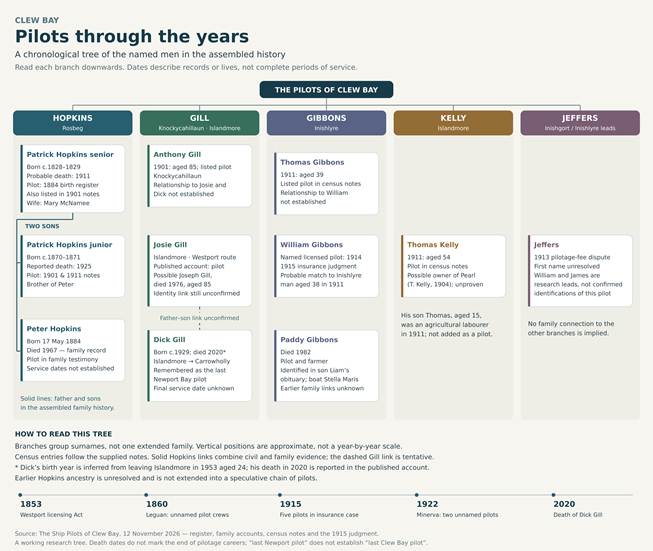
Harbour Pilots identified in the 1901 and 1911 Census Records
By the early twentieth century, five licensed pilots shared Westport’s pilotage receipts, these were likely to have been the two Hopkins of Rosbeg, Tommy Gibbons and William Gibbons of Inishlyre, and Thomas Kelly of Islandmore. The commissioners collected the money and divided it equally among them each quarter. This arrangement had been operating for at least thirty years when it was described in court in 1915. It offered a way of sharing the business, rather than leaving every man’s income dependent on the number of ships he personally reached.
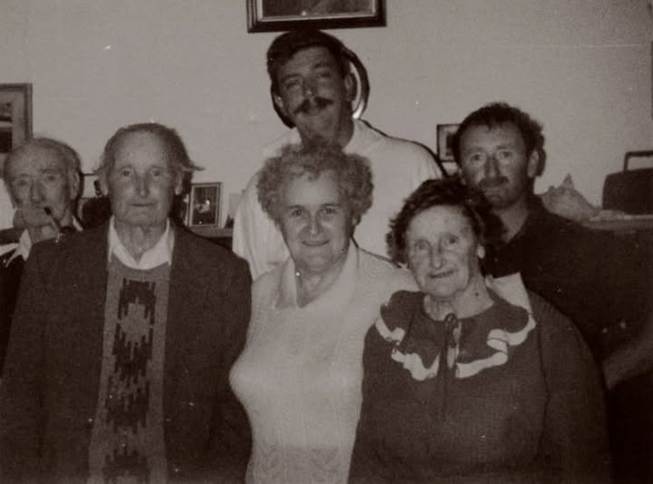
Tommy Gibbons of Inishlyre pictured left front
The men still carried much of the cost. They supplied their own boats and tackle and paid their own crews. They took turns keeping lookout. Other work was permitted provided they fulfilled their pilotage duties, which helps explain why a pilot might also appear in a record as farmer, publican or boatowner.
Their income rose or fell with the business of the port. The quarterly division could distribute the proceeds of a busy season, but it could not create earnings when few ships came. The arrangement also left room for arguments about whether every man was receiving, or attempting to receive, his proper share.
Trouble over the pilotage money
In 1913, that tension surfaced in the harbour office. According to the published account of the exchange, the secretary complained that ‘a man named Jeffers’ wanted to ‘collar’ all the pilotage money and that the other pilots objected. The chairman accepted that they had grounds for complaint.
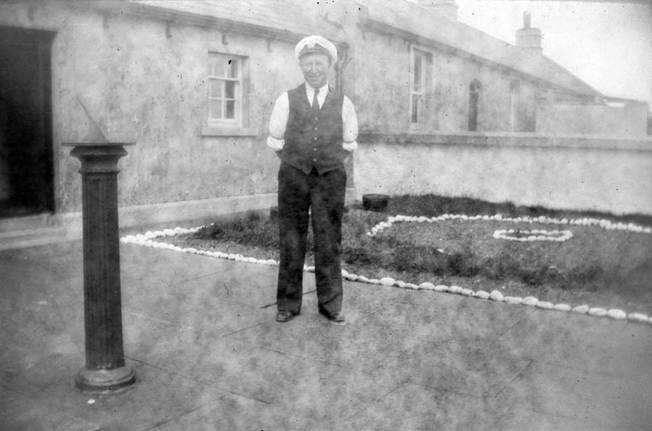
An undated picture taken of an Inishgort Lighthouse keeper identified locally as Jimmy Jeffers
It is a brief glimpse of a dispute, but a revealing one. These men knew that a ship’s arrival had a value. They also knew what it cost to maintain boats and crews. A shared arrangement depended on trust, and any suggestion that one man was taking too much could affect every other household drawing from the same fund.
The Jeffers family belonged to the island world around Inishgort and Inishlyre. Ellen Jeffers was recorded on Inishgort with her adult sons William and James in 1901. By 1911, James was on Inishlyre with his wife Sabina and their infant son Martin. Boats, fishing and the lighthouse formed part of the setting in which the family lived.
The surviving account calls the man in the dispute simply Jeffers. It does not tell us whether he was William or James, nor exactly how he sought to obtain the money. We can hear the complaint without supplying words or motives that were never recorded. What is clear is that the sharing of pilotage earnings could produce rivalry even within an organised service.
The race to reach an incoming ship and the argument in the harbour office belonged to different working arrangements, but both reveal how closely local livelihoods depended on the vessels entering Clew Bay.
Three boats lost beside the Leguan
The reward for pilotage had to be weighed against its danger. In September 1860, three pilot boats were lost while their crews were assisting a single ship.
Leguan was a Glasgow vessel of 349 tons, on passage from Grenada to Greenock with rum, sugar and molasses. She had crossed a great distance before a gale on 13 September brought her into trouble on the Mayo coast. The account of her loss describes shelter near a place called Mayo Island, followed by her drifting into Clew Bay. Near Lecanvey, her position became so dangerous that Captain William Buchanan had the masts cut away.
On 14 September, three pilot boats went out to her. Their men succeeded in getting aboard Leguan, but all three of their own boats sank. The pilots had reached the ship; the craft that had brought them there were under the waves.
The following morning, Buchanan went ashore to seek an anchor and a steam tug. While he was away, fire broke out aboard the vessel. Fearing the powder carried on board, the crew abandoned her and escaped on smaller boats which had come alongside, along with the pilots. Leguan became a total loss.
An inquiry later criticised the captain’s earlier choice of anchorage and his decision to leave the ship in the charge of an officer considered incapable of holding her. The cause of the fire was never established. The pilot-boat crews received a reward of five pounds from the Merchant Mariner Fund, though the account does not make clear how it was divided.
The pilots names have not yet been discovered. The record leaves us with three boats, men who got safely aboard a vessel in distress, and a ship that could not ultimately be saved. For pilots responsible for their own craft, the loss of a boat could also mean the loss of the equipment on which their next earnings depended.
The disaster belongs to the history of the port as much as any successful voyage. Ships carried valuable goods into Clew Bay, but when weather or judgement failed, local men went out to confront the consequences.
Five boys from Islandmore
Thirty-five years later, a tragedy much closer to home brought Patrick Hopkins into another public role. On 1 November 1895, five Kelly cousins from Islandmore went out in a rowing boat to fish. None returned alive.
Joseph Kelly was sixteen and his brother Austin nine. Their cousins, sons of Patrick Kelly, were another Austin, about twelve, Patrick, about ten, and John, about eight. A partly submerged boat was seen near the island. The boys’ fathers and Annie Kelly went to search.
The youngest child was recovered first. The other bodies were found after the tide had receded that night. Two households had lost five children in a single afternoon on the water beside their home.
An inquest was held the next day at Joseph Kelly’s house. Patrick Hopkins served as foreman of the jury. He was not the coroner, but he led the jurors charged with hearing the evidence and reaching a verdict. Among them were Anthony Gill and William Jeffers, names that also appear in the wider story of the bay’s maritime families. The jury returned a verdict of accidental drowning.
The account does not distinguish Patrick senior from his son of the same name, though it was more likely to have been the highly experienced father. It does place a Hopkins pilot’s name at the centre of the community’s formal response to a terrible loss. Men accustomed to earning a living on the bay were now considering how it had taken the lives of children they and their neighbours knew.
The funeral went by boat towards the mainland for burial at Murrisk Abbey. Islanders accompanied the children across the water. The same journeys that linked their homes with markets, work and relatives now carried the dead away for burial.
Islandmore’s Kelly households continued to depend on both land and sea. In 1911, Thomas Kelly, aged fifty-four, was recorded as a pilot. His household included his wife and ten children, while the census marriage details recorded fourteen children born and fourteen living. His fifteen-year-old son Thomas worked as an agricultural labourer. Such a household shows how pilotage fitted into a larger family economy.
Another record names T. Kelly of Island More as owner and master of Pearl, a thirty-six-ton smack that burned at anchor at Inishlyre in December 1904. She was in ballast and nobody was aboard. Thomas the pilot may have been that owner, although the initial alone cannot settle the matter. The boat is another trace of the island’s involvement in the working life of the bay.
The case of fivepence halfpenny
In 1914, the Westport pilots became the subject of a legal argument over fivepence halfpenny. The sum was small. The question behind it was not: who, if anyone, employed them?
The Irish Insurance Commissioners said the Harbour Commissioners should have paid a National Insurance contribution for William Gibbons for the week beginning 29 June. At Westport petty sessions in November, the magistrates found against the harbour authority, although John Walsh, J.P., disagreed. The Harbour Commissioners challenged the decision, and the matter went to the King’s Bench Division.
The case opened a window onto the pilots’ ordinary working arrangements. Five men shared the money collected from pilotage, in equal quarterly portions and without a deduction by the commissioners. They provided their own boats, paid the boat crews and maintained their equipment. Their work was regulated, but they did not receive a fixed wage from the harbour authority.
The commissioners’ argument was that licensing a pilot did not make him their employee. They gave him permission to work, regulated the service and collected the earnings for distribution. In their view, the captain seeking a pilot’s help was the person obtaining his services.
The other side pointed to the authority the commissioners exercised. They chose the pilots, could remove them, controlled the charges and handled the money. Surely, the argument ran, men working under that degree of public control came within the insurance legislation.
One incident in the evidence brought the issue down to the level of a working day on the bay. The younger Patrick Hopkins had been fined five pounds – a large sum at the time – for failing to bring up a boat in rough weather. The money went into the commissioners’ ordinary fund. No date or explanation accompanies the incident. But it showed that the harbour authority’s power over a pilot could carry a substantial financial penalty.
Judgment came on 9 April 1915. Lord Chief Justice Cherry and Justice Gibson decided that the pilots were not employees of the Harbour Commissioners for the purpose of the insurance contribution. The earlier conviction was overturned and the summons dismissed. The Harbour Commissioners had won.
Justice Dodd disagreed. He looked at how the relationship worked in practice and concluded that the men were employed under the public authority. For him, calling the arrangement a licence did not answer the whole question.
The decision left the commissioners without liability for the contribution at issue. It did not declare that pilots could never have insurance or decide every possible obligation of a shipowner. Its importance to the men was more immediate: the body that appointed and regulated them was not required, on these facts, to pay as their employer.
Beyond the courtroom, their responsibilities remained familiar. A ship had to be met, a crew paid and a boat kept seaworthy. The law had defined one part of their position, but the next tide still determined the work.
When an army needed the harbour
On 24 July 1922, local knowledge was called upon for a very different arrival. Minerva, a former cross-channel ferry, came into Clew Bay carrying National Army troops during the Civil War. Aboard were 400 soldiers, 600 rifles, 150 bicycles, an eighteen-pounder gun and a heavy Rolls Royce armoured car.
A pilot arrived at four in the afternoon; another followed an hour later. Both reportedly warned that Minerva was a hundred feet too long to dock safely at Westport Quay. Their names are not given. Myles Mac Evilly, who wrote about the landing, raised the possibility that the advice was intended to mislead, but that remains a suggestion rather than an established explanation.
The landing proceeded. Troops attacked Rosmoney Coastguard Station and the main force subsequently reached Westport. Getting the armoured car ashore required the help of a derrick on the harbour dredger. Its engine driver, Michael O’Grady, and assistant, James Bourke, were later named in correspondence seeking recognition for their help.
For a brief period, the equipment and knowledge of a trading port became part of a military operation. The same questions of depth, space and unloading still applied, regardless of the purpose of the ship or the authority carried by the men aboard.
The Later Island Pilots
The pilots’ families continued to live with the bay as commercial traffic changed. On Inishlyre, Paddy Gibbons combined piloting with a small farm. His son Liam grew up there with his sister Marie, helped on the land and later trained as a mechanic. Years afterwards, he made a model of his father’s sailing boat, Stella Maris.
That model preserved something more personal than a harbour entry. It was a son’s recollection of a boat associated with his father’s life. Paddy died in 1982 and his wife Katie in 1986. Liam’s obituary remembered the pilot and farmer together, as the island household had known him.
The Gill name reaches across several generations of the record. Anthony Gill of Knockycahillaun was eighty-five when the 1901 census notes described him as a pilot. We do not know how often he was still going out at that age, but the occupation remained part of how he was identified.
Josie Gill of Islandmore brought ships towards Westport. He also carried the stories of the islands. Along with Patrick Quinn of Inishcottle, he visited Ernie O’Malley at Burrishoole Lodge, where O’Malley collected local accounts and folklore. The pilot who interpreted the bay for a visiting captain also belonged to the community that remembered its storms, fishing grounds and old tales.
Helen Hooker O’Malley Roelofs made a plaster portrait of Josie, later reported as held by the Clew Bay Heritage Centre. His likeness survives alongside the memory of his occupation. A cemetery entry for Joseph Gill of Islandmore and Carrowholly, who died in 1976 aged eighty-five, may refer to him; the identification still needs to be secured.
Dick Gill’s life carried the story into living memory. He spent his first twenty-four years on Islandmore before the family moved to Carrowholly in 1953. He married Mary Nolan and retained his attachment to the island, returning with Richard to see their land and stock. His daughter Mary Elizabeth interviewed him about the island life he had known.
The family tribute remembers a quiet, patient man, games of twenty-five, political programmes on television and the companionship of Dick and Mary sitting together. It also remembers his pride in having been the last Newport Bay pilot. Here the occupational title belonged to a particular man with a home, a marriage and a lifetime of journeys across familiar water.
Dick died in 2020. His recollections returned to the house on Islandmore, its extinguished fire and the flashing light of Inishgort. Moving to the mainland had not ended his relationship with the place.
Josie is sometimes described as Clew Bay’s last pilot, while Dick is remembered specifically as Newport’s last. Those memories should not be forced into a single title. Westport and Newport had their own traffic and approaches, and the end of one man’s work need not have marked the end of another’s. Nor is the proposed father-and-son relationship between Josie and Dick yet established by the material assembled here.
When the ships stopped coming
Pilotage disappeared gradually as the trade that supported it diminished. There was no single day on which the bay ceased to need local knowledge. There were fewer merchant ships requiring that knowledge as a paid service.
Westport’s decline as a commercial port was already under way by the middle of the twentieth century. Accounts of its history point to the damage caused by the Economic War between Ireland and Britain in the 1930s and the disruption of the Second World War. A port accustomed to exchanging goods and livestock with British destinations was vulnerable when those connections weakened.
Longer-term changes were also working against small ports. Cargo moved increasingly through larger harbours, served by bigger ships and more extensive handling facilities. The government’s National Ports Policy of 2013 explicitly named Westport among the formerly busy ports no longer used by commercial shipping, and described the broader movement of traffic towards larger ports and economies of scale.
Westport’s geography made that change particularly important. The shallows that had created work for pilots and lightermen also imposed costs on trade. A deep-draught ship could anchor at Inishlyre, but her cargo still had to be transferred into smaller boats and brought ashore. Each stage required labour and time. As cargo handling became more concentrated elsewhere, that extra work became a disadvantage for the port, even though it had once sustained so many local livelihoods.
Land transport altered the choices available to merchants too. The railway had helped connect the Quay with the wider country, but goods could also reach the district overland from other ports. Improved road transport made delivery less dependent on a vessel entering Clew Bay. The local loss of work can be understood within that wider change, even where individual firms’ decisions have not yet been traced.
The Quay railway itself faded in stages. Regular freight services had ended in 1941, although occasional goods trains continued into the 1970s; the branch was finally closed in 1978. Its decline accompanied the changing waterfront. It should not be mistaken for a single event that abruptly ended shipping or pilotage.
For the pilots, the consequences followed directly from the way they were paid. Their income came from the ships they served. Dividing the receipts among the men could share the work’s rewards, but it could not preserve a livelihood after the traffic dwindled. Boats and equipment still cost money to maintain, while fewer arrivals offered fewer earnings. As older men retired or died, there was less reason for another generation to take their place in the same occupation.
The islands were changing too. Families moved ashore, children pursued different work and communities that had supplied crews became smaller. These changes accompanied the decline in shipping rather than providing a complete explanation on their own. The bay retained able boatmen; it lost much of the merchant traffic that had required a separate body of ship’s pilots.
The waterfront found other uses. Former warehouses became shops, restaurants and places to stay. Fishing, recreation and tourism continued to bring people onto the water. The railway route became a place to walk and cycle. At the Idle Wall, the memory of men waiting for a day’s employment outlasted the pattern of work that had gathered them there.
The pilots left fewer visible monuments than the merchants whose warehouses still face the harbour. Their record lies in licences, census returns and a court judgment; in a portrait of Josie Gill; in the model of Paddy Gibbons’s boat; and in the recollections of children whose father could not get home because the weather had turned.
Their importance is easiest to understand by returning to an incoming ship. Before her cargo could become a merchant’s stock, a railway load or a day’s work for men at the Idle Wall, someone had to bring her safely through Clew Bay. For generations, that responsibility rested with the men who came out to meet her.
The full story of the Clew Bay pilots is far from complete, but this account sets the foundation for recollections from those who knew these men and their extraordinary relationship with the Atlantic Ocean.
If you or anyone you know might have further information on any of the Clew Bay Pilots, please contact [email protected]
Notes on the sources
- The opening race draws on John Mulloy’s account, recorded by Chuck Meide in the Institute of Maritime History field report of 27 June 2006. It confirms competition among outer-bay pilots and a turn-taking system farther in, but does not date the end of competition to 1853. The pre-1853 framing follows the local tradition supplied for this rewrite; the Act is a firm legal milestone, not proof that all racing stopped that year. https://www.maritimehistory.org/2006/06/27/achill-island-field-report-arrival-in-westport-and-clew-bay/
- The Idle Wall description comes from Liamy MacNally, “Down to Roman Island and the Point,” Mayo News, 23 February 2021. Cargoes and the railway connection are also described in Mayo Ireland’s Old Railway Line Walk account and Eiretrains’ Westport history. Sources differ between 1874 and 1875 for the Quay extension; “mid-1870s” avoids implying that this discrepancy has been resolved. https://www.mayonews.ie/news/down-to-roman-island-and-the-point-7509723 ; https://www.mayo-ireland.ie/en/things-to-do/outdoor-activities/walking/family-walks/old-railway-line-walk.html ; https://www.eiretrains.com/Photo_Gallery/Railway%20Stations%20W/Westport/IrishRailwayStations.html
- Inishlyre’s population, facilities and lifeboat history follow Michael Cusack’s “Inishlyre — The Clew Bay Island that welcomed the world.” The cargo-transfer account is also supported by Mulloy’s maritime recollections. https://thereek.com/inishlyre/
- The Hopkins family sections draw on Paddy Hopkins’s “Hopkins Family Origins,” the family notes and the civil birth registration of Peter Hopkins, 17 May 1884. The Spirit excursion notice is from the Mayo Examiner, 22 June 1874. The flood recollections appear in Linda Cusack’s Irish Times article of 19 April 2019 and Áine Ryan’s Mayo News account of Gerardine’s centenary, 9 April 2019. Conflicting details of the early pedigree, pub licences and Spirit’s loss remain unresolved.
- The Jeffers dispute is reported by Dan MacCarthy in “Islands of Ireland: Leading light of Clew Bay,” Irish Examiner, 8 June 2021. The account does not establish Jeffers’s first name. https://www.irishexaminer.com/property/homeandgardens/arid-40305872.html
- Leguan and Pearl appear in Frank Coyne’s archaeological assessment for the Newport Sewerage Scheme, December 2004, pp. 29–32. It cites Parliamentary Papers 1861, LXIII, pp. 418 and 432 for Leguan, and 1906, CVIII, pp. 147 and 637 for Pearl. https://epawebapp.epa.ie/licences/lic_eDMS/090151b280287bf0.pdf
- The Islandmore account follows Tom Gillespie, “From the archives: Drowning tragedy in Clew Bay in 1895 recalled,” Connaught Telegraph, 23 May 2026. Patrick Hopkins was foreman of the inquest jury, not the presiding coroner; the report does not distinguish father from son. https://www.con-telegraph.ie/2026/05/23/from-the-archives-drowning-tragedy-in-clew-bay-in-1895-recalled/
- The court case is Westport Port and Harbour Commissioners v Irish Insurance Commissioners, [1915] 2 I.R. 283–310, supplied in full. The stated facts and licence are on printed pp. 284–289; the majority judgments and Dodd’s dissent explain the different views of the pilots’ status. Five pilots were serving at the time; this does not establish a permanent statutory limit of five.
- The Minerva episode follows Myles Mac Evilly, “The arrival of the National Army in Clew Bay, 24 July 1922,” History Ireland. The two pilots are unnamed. https://historyireland.com/the-arrival-of-the-national-army-in-clew-bay-24-july-1922/
- Paddy Gibbons’s family and boat are remembered in Liam Gibbons’s obituary, Mayo News, 23 April 2009. Josie and Dick Gill appear in Dan MacCarthy’s Irish Examiner article of 2 June 2023; Dick’s family tribute is reproduced in the supplied notes. Josie’s connection with Ernie O’Malley is discussed by John Healy in Mayo News, 3 January 2025. The proposed Joseph Gill cemetery identification and the Josie–Dick relationship remain provisional. https://www.mayonews.ie/news/opinion/liam-gibbons-7503845 ; https://www.irishexaminer.com/lifestyle/outdoors/arid-41143315.html
- For the decline, Tom Gillespie’s “Mayo ports, whaling stations and maritime activities,” Connaught Telegraph, 18 July 2026, draws on Rosa Meehan’s The Story of Mayo (Mayo County Council, 2003) and identifies the Economic War and Second World War as contributing factors. National Ports Policy (2013), section 2.3, provides the wider context of larger ships and concentration of freight at larger ports, explicitly naming Westport. The discussion of lighterage costs and reduced pilot earnings explains the implications of those changes; it is not a recovered statement from an individual pilot. No exact final pilotage voyage has been established. https://www.con-telegraph.ie/2026/07/18/mayo-ports-whaling-stations-and-maritime-activities/ ; https://assets.gov.ie/static/documents/national-ports-policy.PDF