For generations, Reek Sunday did not begin on Sunday morning. It began in darkness.
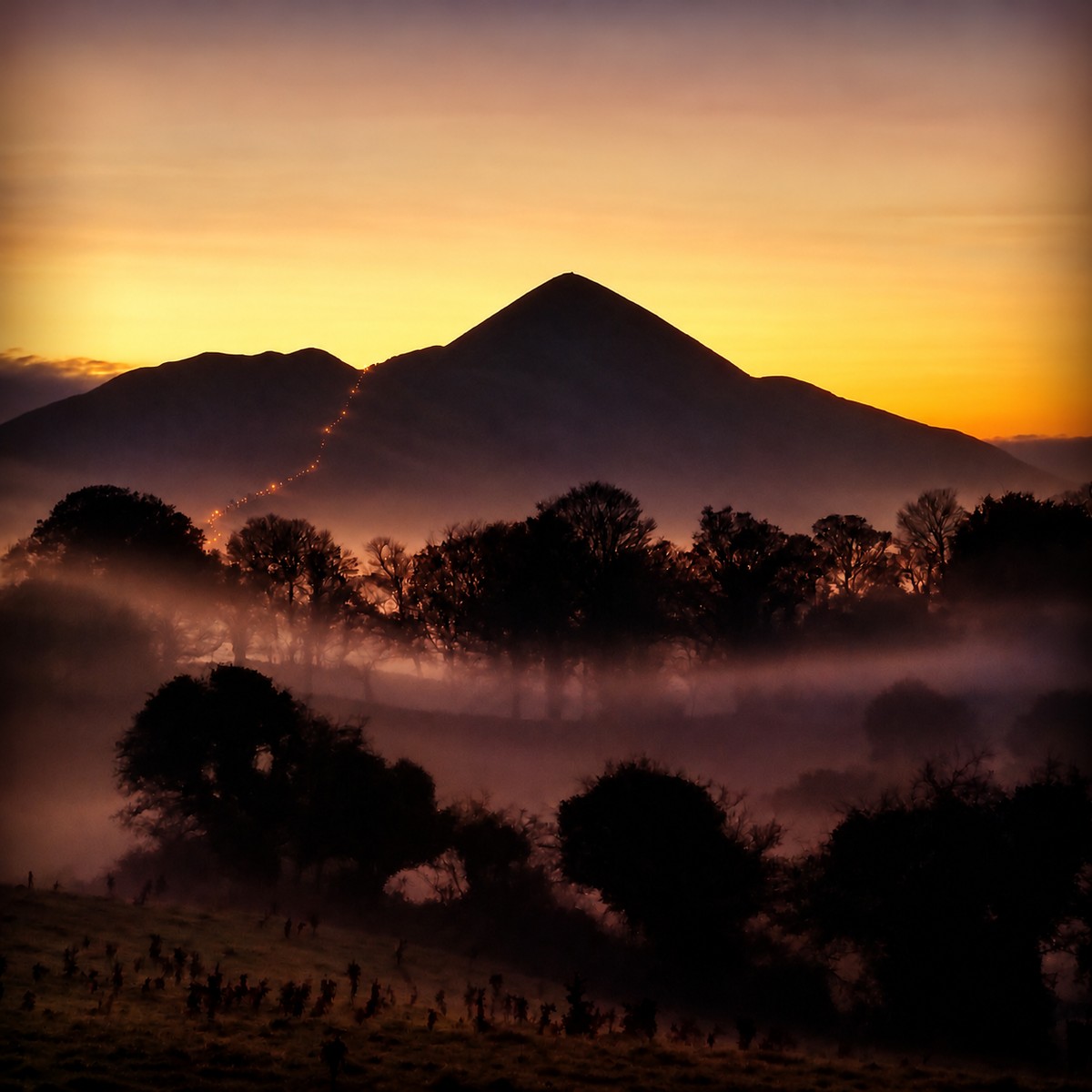
On Saturday evening, pilgrims gathered at Murrisk and started climbing Croagh Patrick as daylight faded. Some climbed barefoot. Others carried sticks, lamps or torches. Many reached the summit in the small hours and remained there for Mass, confession or prayer before beginning the descent as dawn broke over Clew Bay.
Today the annual pilgrimage is overwhelmingly a daylight event. But within living memory, the night climb was one of the defining features of Reek Sunday.
A tradition far older than the modern pilgrimage
The practice of keeping vigil on Croagh Patrick was not a twentieth-century invention. One of the earliest written references to pilgrimage on the mountain comes from the year 1113. The Annals of Ulster record a disastrous event on the night of the feast of St Patrick, when thirty people who were fasting on the mountain were killed in what was described as a “ball of fire” — probably a violent lightning event.
A twelfth-century account of the life of St Patrick also describes pilgrims spending the night awake and fasting on the mountain. This suggests that night vigils had already become an established part of the pilgrimage many centuries ago.
The mountain’s Christian association itself is older still. By the seventh century Croagh Patrick was already linked with St Patrick, and tradition held that he had fasted there for forty days and nights. Archaeological work on the summit has also identified an early oratory dating broadly between the fifth and ninth centuries.
The revival of the pilgrimage
By the beginning of the twentieth century, the modern Reek Sunday pilgrimage was being revived on a much larger scale.
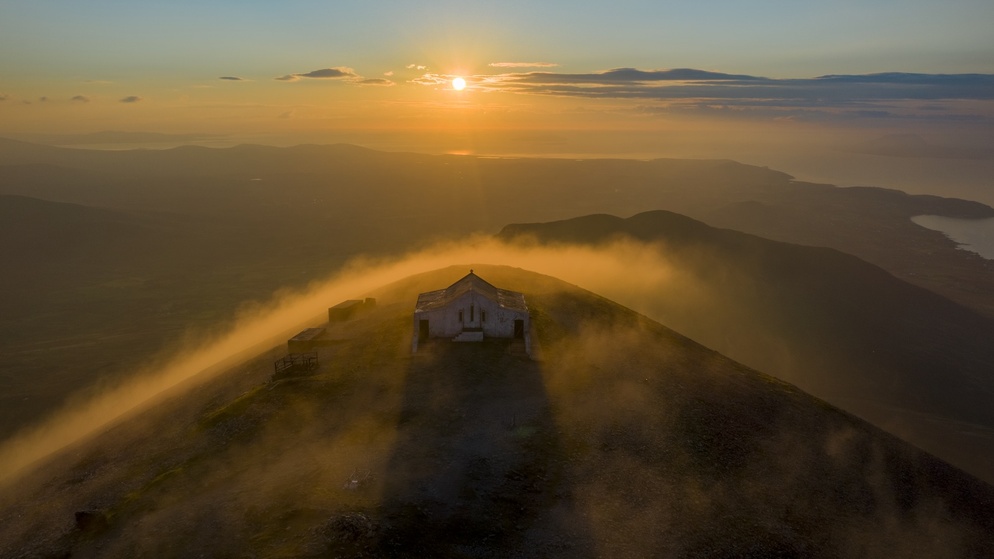
Archbishop John Healy of Tuam played a central role in that revival from 1903, and the present summit chapel was built soon afterwards. By 1910, thousands were again making the climb.
Accounts from the period describe older pilgrims going up the evening before and spending the night on the mountainside or praying around the summit chapel. One contemporary description speaks of people who had endured a wet and stormy night on the mountain before descending exhausted the following morning.
Thousands climbing after sunset
By the 1930s, the night pilgrimage had become a major annual event.
A Connaught Telegraph report from 1934 described thousands beginning the ascent after sunset on Saturday and keeping vigil through the night. That year the weather was particularly bad. Heavy rain made the lower slopes slippery, while cloud covered the mountain and made it difficult for pilgrims to remain on the path. Those carrying electric torches helped others find their way.
The busiest period was apparently not in daylight at all. The newspaper noted that the real rush of pilgrims took place between roughly one and six in the morning.
Seen from below, the mountain must have presented a remarkable sight: a broken line of lamps and torches slowly moving upwards through the darkness.
Westport stayed awake too
The night pilgrimage changed Westport and Murrisk for that one weekend each year.
In the 1950s and 1960s, special trains carried thousands of pilgrims to Westport from around the country. Buses then brought them on to Murrisk. Contemporary recollections describe pubs in Westport and Murrisk remaining open through the night as the crowds moved towards and away from the mountain.
The pilgrimage therefore became more than a religious event. It was also a huge social gathering.
At the foot of the mountain, hawkers sold walking sticks, rosary beads and religious pictures. Refreshment tents appeared along the route. The higher one climbed, the more expensive the refreshments became.
There was also a strange mixture of solemnity and festivity. Prayer, penance and physical hardship existed alongside crowds, drinking, trading and the simple excitement of being out all night.
Barefoot in the dark
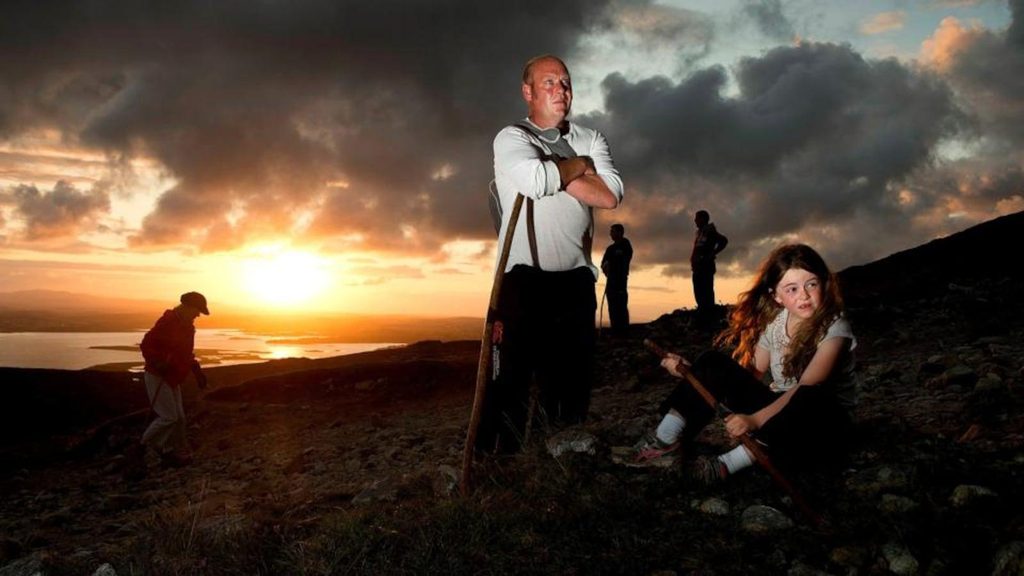
Many pilgrims still climbed barefoot.
In daylight, the loose stone of Croagh Patrick is difficult enough. In darkness, every step became uncertain. Rocks were hidden, the path was poorly defined and wet weather could turn the lower mountain into mud.
Yet this hardship was part of the meaning of the pilgrimage for many people. RTÉ’s 1970 coverage showed men and women, young and old, climbing in wet, cold and windy conditions, some without footwear, during what was described as one of the worst nights in years. Around 15,000 pilgrims were reported on the mountain.
Three years later, RTÉ again recorded Mass and confessions continuing through the night on the summit, while pilgrims descended as others were still making their way upwards.
The end of the nocturnal pilgrimage
By the 1970s, however, attitudes were changing.
The sheer numbers, the dangers of climbing in darkness, and the increasing social and drinking element around the pilgrimage all caused concern. A later recollection states that church authorities ended the traditional night pilgrimage in 1976 in favour of a daylight climb, with all-night drinking cited as one factor.
By 1979, RTÉ reported that the pilgrimage was being held during daylight hours in accordance with the wishes of Archbishop Joseph Cunnane of Tuam.
A custom that had lasted in one form or another for centuries had largely disappeared.
A different Reek Sunday
The modern Reek Sunday pilgrimage remains a major religious and cultural event, but its atmosphere is very different.
Today most pilgrims begin in daylight. The path is clearer, emergency support is better organised and the experience is less hazardous than the old overnight climb.
But something was also lost.
Those who remember the nocturnal pilgrimage describe a mountain alive through the night — trains arriving in Westport, buses heading for Murrisk, lights moving slowly up the dark slopes, prayers at the summit, tired pilgrims descending at dawn and the first light spreading across Clew Bay.
For centuries, part of the pilgrimage to Croagh Patrick involved not simply climbing the mountain, but enduring the night upon it.
And for many older people in Mayo, Reek Sunday still brings back memories of a time when the mountain never slept.
Do you remember the night pilgrimage?
If you climbed Croagh Patrick at night, or if your parents or grandparents spoke about doing so, we would be very interested to hear your memories.
What time did you start? Did you carry a torch? Did you go barefoot? Do you remember the trains, buses, all-night crowds in Westport or Mass on the summit before dawn?
Those memories are now part of the history of the Reek.