What three censuses reveal about the families who lived among Clew Bay’s islands
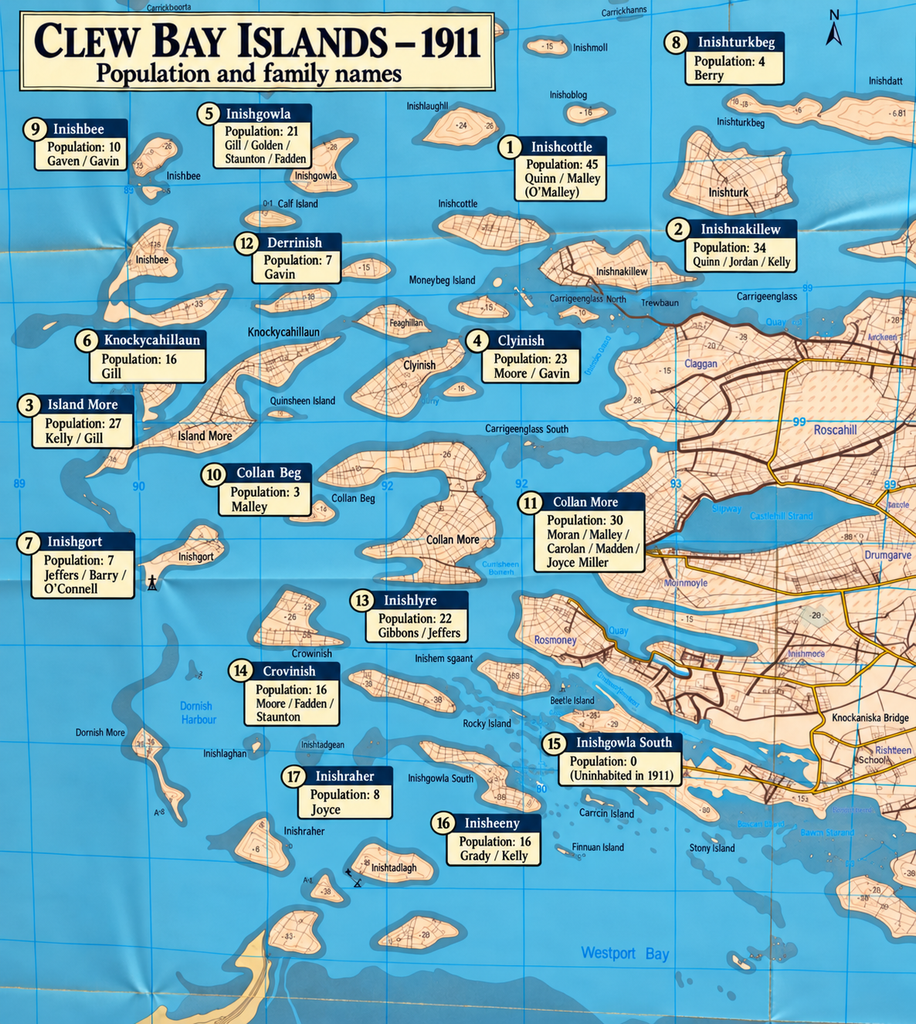
At the beginning of the twentieth century, Clew Bay was home to a remarkably diverse collection of island communities. Some islands supported fifty or sixty people, with several families raising children and working the land and sea. Others were occupied by just a handful of individuals, often sharing a single surname.
The Irish census returns for 1901, 1911 and 1926 allow us to follow these communities over a quarter of a century. The records reveal a story of declining populations, ageing inhabitants, changing family structures and, in some cases, the gradual disappearance of entire island settlements.
They also contain fascinating irregularities. Some islanders apparently aged twenty years between two censuses taken ten years apart. Others seem barely to have aged at all. Such discrepancies are reminders that birth dates were not always known precisely, recorded accurately or consistently reported.
The following account examines these changes island by island, using the entries in the three census worksheets.
The changing population of the islands
The first striking observation is that population decline was widespread, although it was by no means uniform.
The table below shows the number of individuals recorded in each worksheet for the relevant census year. An em dash means that no entry was supplied for that island in that year, not necessarily that its population was zero. These appear to have been the only islands in Clew Bay that were populated at the time.
| Island | 1901 | 1911 | 1926 |
|---|---|---|---|
| Collan More | 59 | 30 | 21 |
| Inishcottle | 27 | 45 | 30 |
| Inishnakillew | 41 | 30 | 16 |
| Clynish | 30 | 23 | 18 |
| Islandmore | 29 | 27 | 14 |
| Inishgowla | 24 | 21 | 15 |
| Inishlyre | 23 | 22 | 21 |
| Knockycahillaun | 21 | 16 | 12 |
| Inishbee | 18 | 10 | 5 |
| Crovinish | 14 | 16 | 11 |
| Inishgort | 9 | 7 | 13 |
| Inishraher | 11 | 8 | 3 |
| Derrinish | 8 | 7 | 3 |
| Collan Beg | 4 | 3 | 2 |
| Inishtubbrid | 15 | 11 | — |
| Inishturk Beg* | 8 | 4 | — |
| Moynish Island | 4 | 2 | — |
| Inisheeny | — | 16 | — |
| Rosturk Island | 17 | — | — |
Inishturk Beg is recorded as Inishturk in the census records. Inishtubbrid may have been evacuated between 1911 and 1926. Rosturk Island appeared in the 1901 census, but may have been included with the Rosturk penninsula population after a small bridge was built to connect the ‘island’ to the mainland. Inisheeny appeared only once in census records, but it may have been an oversight on the part of the census takers in 1901 and 1926.
The most dramatic pattern emerges when we examine the fourteen islands represented in all three census years.
Together, they had 318 recorded inhabitants in 1901, 265 in 1911 and just 184 in 1926.
That represents a decline of approximately 42% over 25 years.
The figures also demonstrate that the process was uneven. Some islands were losing people steadily from 1901 onwards, others experienced temporary growth, and Inishgort actually increased its recorded population between 1911 and 1926.
Inishcottle: From a flourishing community to a shrinking population
Inishcottle presents one of the most interesting demographic histories.
Its population rose from 27 in 1901 to 45 in 1911, an increase of almost 67%. By 1926, however, it had fallen to 30.
The island was dominated by the Quinn and Malley/O’Malley families.
The most remarkable change was in the number of children. In 1901, sixteen inhabitants were younger than fifteen. By 1911 that figure had reached 27, accounting for 60% of the island’s entire population.
Fifteen years later, in 1926, only nine children under fifteen remained. Just one was younger than five.
The census records therefore suggest a major change in the island’s family structure. A community with numerous young children in 1911 had become substantially less youthful by 1926.
The individual names also allow us to trace probable family continuity.
Rose Quinn, aged four in 1901, appears to correspond with Rose Quinn, aged fourteen in 1911. Kate Quinn progresses from three to thirteen over the same interval.
Walter O’Malley presents a less straightforward case. A Walter Mally was recorded as forty in 1901, Walter OMalley as 58 in 1911, and Walter O’Malley as 71 in 1926. If these records refer to the same person, his reported age increased by eighteen years during the first decade and thirteen during the following fifteen years.
His apparent wife or family member Alice shows a similarly irregular progression: 26 in 1901, 39 in 1911 and 52 in 1926.
It is possible that some of these ages were estimates, but the exact relationships and identities require household-level confirmation.
Whatever the explanation, the island’s population history illustrates a significant change: growth and youthful families before 1911, followed by sharp contraction.
Collan More: A dramatic decline
Collan More was the most populous of the islands in the supplied 1901 records, with 59 inhabitants.
By 1911, the worksheet contains only 30 residents, and by 1926 that number had fallen further to 21.
The changing surnames are interesting.
In 1901, the principal family names included Moran, Casey, O’Malley and Carolan. The Casey surname accounted for twelve people, but does not appear in the 1911 Collan More entries.
By 1911, the records include the Joyce Miller family, several of whose members were born in England, along with the Moran, Malley, Carolan and Madden families.
In 1926, the surnames were Moran, O’Malley and Carlin.
The appearance and disappearance of surnames suggests considerable change in the island’s household composition, although we cannot determine from the census alone whether families emigrated, moved to other islands, or were simply absent on census night.
The number of children under fifteen fell from nineteen in 1901 to five in 1911 and three in 1926.
Interestingly, all three children under fifteen recorded in 1926 were younger than five, indicating that at least one young family was still raising children.
Among the individuals worth investigating is Thomas Moran, recorded as 67 in 1911 and 78 in 1926. If he was the same man, he had aged only eleven years over a fifteen-year interval.
This is a good example of why some census ages should be treated as reported rather than exact dates of birth.
Inishnakillew: The Quinn families and a diminishing community
Prior to the construction of a causeway in the 1930s that connected the island to the mainland, Inishnakillew’s population declined from 41 in 1901 to 30 in 1911 and 16 in 1926.
This amounts to a reduction of approximately 61% over 25 years.
The principal surnames were Quinn and Jordan, with occasional Kelly residents.
The records illustrate the challenge of tracing island families where names recur frequently. Multiple Patrick Quinns, John Quinns, Michael Quinns and Mary Quinns appear across the returns.
The island had fourteen children under fifteen in 1901, six in 1911 and just two with recorded ages under fifteen in 1926.
The 1926 return includes several adults in their thirties, as well as children aged two and less than one. It therefore shows a reduced but continuing younger generation.
The presence of so many repeated names also offers an opportunity to trace relationships between the Quinn families of Inishnakillew and those on Inishcottle.
The same surname, and the repetition of names such as Austin, Owen and Patrick, make a connection plausible. But these clues do not establish kinship without marriage, birth or household records.
Clynish: Gradual decline rather than sudden abandonment
Clynish had thirty inhabitants in 1901, twenty-three in 1911 and eighteen in 1926.
Its principal surnames, Moore and Gavin, continued throughout the period.
In 1901, seventeen inhabitants were under fifteen, representing more than half the island’s population.
By 1911, that figure had fallen to seven, and it remained at seven in 1926 among those whose ages were recorded.
Unlike several of the smaller islands, Clynish continued to have young children in 1926, including Mary Gavin, aged three, and Willie Moore, aged four.
This suggests that family life and childbirth continued despite the island’s declining population.
The records also contain intriguing possible family connections.
Michael Gavin was recorded as 73 in 1911 and 87 in 1926, a plausible progression of fourteen years over fifteen.
The Gavin surname also appears on nearby Derrinish and Inishbee. The recurrence of the surname across these islands suggests a potentially extensive network of related families.
Islandmore: A particularly striking loss of children
Islandmore’s population declined from 29 in 1901 to 27 in 1911 and fourteen in 1926.
The Kelly and Gill families dominated the records, with Malley/O’Malley also appearing in the earlier censuses.
Perhaps the most striking change concerns the children.
In 1901, fifteen inhabitants were under fifteen. In 1911, there were ten.
By 1926, not one of the fourteen recorded inhabitants was younger than fifteen.
The youngest was Joseph Kelly, aged fifteen.
The Kelly household included young adults such as Thomas, John, Walter, William, Michael, Norah and Florence, but no small children.
This does not establish that the community was about to disappear, but it suggests a serious interruption in the renewal of its younger population.
The Gills remained represented, with John Gill, aged 64, James Gill, aged 70, and Mary Ann Gill, aged 73, among the older inhabitants.
Islandmore provides a particularly vivid example of how the families of Clew Bay gradually spread far beyond the islands.
In 1911, twenty-seven people were living in four small houses on Islandmore. Among the families long associated with the island were the Kellys. The memoir included in Croagh Patrick and the Islands of Clew Bay specifically remembers “the Kellys of Islandmore”, one of the families who formed part of the close-knit community around the inner bay. Croagh Patrick and the Islands … Croagh Patrick and the Islands …
One of them was Agnes Kelly, daughter of Thomas Kelly and Margaret McHale. Family tradition remembers Agnes as a midwife who served the island communities before her life took her away from Clew Bay.
In December 1910 she married Richard Ryan, a Post Office clerk from County Kilkenny. Richard later joined the Royal Engineers and served in Mesopotamia during the First World War, working in military signals and telegraphy.
Their marriage was tragically short. In the autumn of 1918 their infant daughter Mary Angela died during the great influenza epidemic. Richard himself died of influenza and pneumonia only days later, on 6 November 1918, two days before his thirty-third birthday.
Agnes was left a young widow with small children. She returned to Kilkenny, where she later established St Philomena’s Nursing Home, subsequently known as Lacken House. Her sons went on to establish professional and business careers in Kilkenny.
Yet the family connection with Islandmore survived. Descendants still maintain a holiday home there today — remarkably, a house without electricity, despite one of Agnes’s descendants becoming an electrician.
It is a small but telling example of what happened across Clew Bay. The island communities did not simply disappear. Their people carried the islands with them.
Inishgowla: Decline, continuity and the mystery of age
Inishgowla’s population fell from 24 in 1901 to 21 in 1911 and fifteen in 1926.
Its principal families were the Gills, Goldens, Stauntons and Faddens.
By 1926, the return included Gill, Staunton, O’Halloran and Lally residents, but no Goldens.
The disappearance of the Golden surname from the 1926 island return is worth investigating. The family had accounted for eleven recorded inhabitants in 1901 and seven in 1911.
Perhaps the most extraordinary detail concerns Bridget Gill.
She was recorded as 92 years old in 1901 and again as 92 in 1911.
If both entries refer to the same woman, she apparently did not age at all between the censuses.
The discrepancy may result from an incorrect age, a transcription problem, two different individuals or some other recording issue. It cannot simply be assumed that she did not know her birthday.
Meanwhile, children continued to be born on Inishgowla. The 1926 return includes Thomas Martin Staunton, recorded as an infant, Joseph Staunton aged one, and Mary Staunton aged three.
Thus, despite its population decline, the island still supported young children in 1926.
Inishlyre: Remarkable population stability
Inishlyre provides one of the most interesting contrasts with the general pattern.
Its population was 23 in 1901, 22 in 1911 and 21 in 1926.
Over 25 years, its recorded population declined by just two people.
The Gibbons surname dominated the community, especially in 1911 and 1926.
The 1911 return included several infants, among them Elizabeth Gibbons, John Joseph Gibbons, William Joseph Gibbons and Martin Jeffers, all recorded as aged zero.
By 1926, the Gibbons family remained numerous, with twenty of the 21 residents bearing that surname.
There were eight children under fifteen with recorded ages, including Margaret Gibbons, aged four, Austin Gibbons, aged six, and Peter Gibbons, aged seven.
The island therefore retained both its overall population and a substantial younger generation.
Inishlyre’s comparative stability raises an interesting question: was its economy, landholding structure or access to the mainland more favourable than that of islands experiencing rapid decline?
The census cannot answer that question, but it identifies Inishlyre as an important exception worthy of further research.
Knockycahillaun: An ageing population
Knockycahillaun’s population declined steadily from 21 in 1901 to sixteen in 1911 and twelve in 1926.
The Gill family predominated throughout the period, alongside smaller numbers of Kelly and Moore residents. This is not surprising, as this island is connected to Islandmore.
The 1901 return contains a particularly remarkable entry: Richard Gill, whose age was recorded as 100 years.
If accurate, he was the oldest individual in the entire collection of island records.
However, the subsequent censuses contain other age inconsistencies among the Gill families, illustrating the need for caution.
By 1911, the youngest inhabitant was Richard Gill, aged fifteen. In 1926, the youngest person was Nora Gill, aged eighteen.
There were no children under fifteen in either return.
Five of the twelve residents in 1926 were aged 65 or over, among those whose ages were supplied.
These figures indicate a community becoming increasingly elderly, with few signs of population renewal.
Crovinish: Growth followed by decline
Crovinish had fourteen inhabitants in 1901, sixteen in 1911 and eleven in 1926.
The principal surnames were Moore, Fadden and Staunton, with Fadden appearing as McFadden in the 1926 return.
The growth between 1901 and 1911 was modest, but significant because it contrasts with the decline experienced on many other islands.
In 1911, seven inhabitants were younger than fifteen. By 1926, only one was under fifteen: Brigid McFadden, aged thirteen.
The 1926 return contains eight McFaddens and three Moores.
The change from Fadden to McFadden may be a difference in naming or transcription, rather than evidence of a separate family.
Crovinish is also interesting for its possible connections with Inishgowla, where the Fadden surname occurs in the earlier records.
These cross-island connections deserve genealogical investigation.
Inishbee: From eighteen inhabitants to five
Inishbee experienced one of the largest proportional declines.
Its population fell from eighteen in 1901 to ten in 1911 and just five in 1926.
That represents a reduction of approximately 72% over 25 years.
The Gavin, Gaven and Gavan surnames appear throughout the records.
In 1901, there were six children under fifteen. By 1911, there were none, and the youngest inhabitant was Bridget Gaven, aged twenty.
The situation was similar in 1926. All five residents were adults, ranging in recorded age from 33 to 47.
This is particularly interesting because the remaining inhabitants were not predominantly elderly. Rather, the island consisted entirely of adults of broadly working age.
That suggests a different demographic pattern from islands such as Knockycahillaun.
One possibility is that younger people remained on Inishbee but fewer families were raising children there. Other explanations, including temporary absence, migration and changes in household composition, remain possible.
Inishgort: The island that reversed the trend
Inishgort stands out because its population increased substantially between 1911 and 1926.
It had nine inhabitants in 1901 and seven in 1911, but thirteen in 1926.
This was an increase of approximately 86% during the final fifteen years.
The Jeffers surname was present throughout, while the Barry and O’Connell names appeared in earlier returns.
By 1926, the island was occupied principally by Jeffers and James residents.
An important possible family connection emerges here.
James Jeffers, aged forty in 1911, was recorded on Inishlyre with Sabine Jeffers, aged 26, and their infant son Martin.
In 1926, Inishgort includes James Jeffers, aged 57, Sabina Jeffers, aged 40, and Martin Jeffers, aged fifteen, alongside several younger Jeffers children.
The combination of names and ages strongly suggests that this may be the same family, although the original household records would be needed to confirm the relationship.
If so, it is a particularly valuable example of population movement between the islands themselves, rather than straightforward emigration from Clew Bay.
Inishgort’s population growth may therefore have been influenced by the arrival of families from neighbouring islands.
There were also four children under fifteen with recorded ages in 1926, suggesting that its demographic position had improved.
Inishraher: A community reduced to three people
Inishraher’s population fell from eleven in 1901 to eight in 1911 and just three in 1926.
The earlier returns included Joyce, Jordan, Kelly and Kerrigan residents.
By 1926, only the Joyce surname remained.
The three inhabitants were Pat Joyce, aged seventy, Nora Joyce, aged 72, and Patrick Joyce, aged thirty.
These may represent two generations of one family, although the household relationship requires verification.
The 1901 and 1911 returns show that younger Joyce family members were living on the island earlier in the century.
Their reduced presence by 1926 suggests that Inishraher had undergone a substantial contraction in family and household numbers.
It had lost nearly three-quarters of its recorded population over 25 years.
Derrinish: The shrinking Gavin settlement
Derrinish had eight inhabitants in 1901, seven in 1911 and three in 1926.
The Gavin/Gaven surname dominated the island throughout.
In 1901, six of its eight inhabitants were children under fifteen. By 1911, only one was under fifteen.
By 1926, there were just three adults: Bridget Gavin, aged 71, Thomas Gavin, aged thirty, and Mary Gavin, aged 25.
The figures suggest a settlement that had changed from a youthful family community into a very small adult household.
Given the concentration of Gavin families on Derrinish, Clynish and Inishbee, there may have been extensive kinship links between these islands.
Tracing these connections could help explain where younger family members went as individual island populations diminished.
Collan Beg: From four inhabitants to two
Collan Beg was one of the smallest island communities.
It had four recorded residents in 1901, three in 1911 and two in 1926.
The earlier returns include the O’Malley/Malley surname and one Quinn.
In 1911, Anne Malley was 75, Mary Malley was 43 and John Malley was forty.
By 1926, John O’Malley, aged 56, and Mary O’Malley, aged 65, were the only recorded inhabitants.
John’s reported age increased by sixteen years over fifteen years, making him a plausible match for the younger John Malley of 1911.
Mary, however, increased from 43 to 65, a difference of 22 years.
If these are the same individuals, the ages are significantly inconsistent.
The records illustrate both the persistence of island households and the difficulties of reconstructing their histories from census information alone.
Inishtubbrid: The McHale families
Inishtubbrid was occupied entirely by McHales in the supplied 1901 and 1911 returns.
The population declined from fifteen to eleven.
In 1901, seven inhabitants were under fifteen, including Ellen and Sarah McHale, both aged eight.
By 1911, the youngest resident was Edward McHale, aged nineteen. There were no children under fifteen.
Five of the eleven recorded inhabitants were aged 65 or older in 1911.
This remarkable change in age distribution suggests an ageing community.
No Inishtubbrid entries appear in the supplied 1926 worksheet. That is not sufficient evidence that the island was uninhabited by then; a complete 1926 return or official population table is needed.
Inishturk Beg: The Berry family
The worksheet records eight Berry family members on Inishturk in 1901 and four in 1911.
The four 1911 residents were Mary Berry, aged 68, Alice Berry, aged 29, Martin Berry, aged 26, and Patrick Berry, aged 23.
The youngest recorded inhabitant was therefore an adult.
However, there is an unresolved discrepancy between this extract and the separately identified figure of twelve inhabitants in 1911.
Consequently, it would be premature to conclude that Inishturk Beg’s population had halved.
No entry appears in the 1926 worksheet.
Moynish Island: The McIntyre household
The 1901 return for Moynish More contains four McIntyres: Patrick, Bridget, Norah and Michael.
By 1911, only Patrick and Bridget McIntyre appear in the supplied Moynish Island return.
Patrick was recorded as 56 in 1901 and 67 in 1911. Bridget was sixty in 1901 and 72 in 1911.
These are reasonably consistent age progressions.
The absence of Norah and Michael in the 1911 return raises questions about their subsequent lives. They may have married, moved, emigrated or died, but none of these possibilities can be established from these census extracts.
No corresponding Moynish Island entries appear in the 1926 worksheet.
Inisheeny and Rosturk Island: Incomplete comparisons
Two further islands appear in only one of the three sets of records.
Inisheeny has sixteen inhabitants recorded in 1911, principally members of the Grady and Kelly families. Its population included young children, including Thomas Grady, aged one.
Rosturk Island has seventeen residents recorded in 1901, principally Gannon and Johnston family members, together with an O’Malley resident.
Neither island has sufficiently complete entries across the three worksheets to support a population trend.
They should nevertheless form part of any wider study of Clew Bay’s inhabited islands.
What was happening to the island communities?
Several important conclusions emerge.
1. Depopulation was widespread, but not inevitable
Most of the islands represented across all three censuses lost population.
Some declined dramatically, particularly Inishbee, Inishraher and Collan More. Others, such as Inishlyre, remained remarkably stable.
Inishgort actually grew.
This variation suggests that local circumstances mattered. Access to land, fishing opportunities, housing, household succession and migration may all have influenced the fortunes of individual communities.
2. The disappearance of children may be the most important finding
In several island communities, the decline in the number of children was even more dramatic than the fall in the total population.
Islandmore had fifteen children under fifteen in 1901 and none in 1926.
Knockycahillaun had seven children under fifteen in 1901 and none with recorded ages under fifteen in either 1911 or 1926.
Inishbee had six in 1901 and none in the later two returns.
Inishcottle’s child population fell from 27 in 1911 to nine in 1926.
These changes suggest that the demographic foundations of some island communities were weakening well before their final abandonment.
3. Families were probably moving between islands
The surnames recurring across different communities provide evidence of possible family networks.
The Quinns were prominent on Inishcottle and Inishnakillew.
The Gill surname occurred on Islandmore, Inishgowla, Inishlyre and Knockycahillaun.
The Moore name appeared on Crovinish and Clynish, while the Gavin/Gaven families were particularly prominent on Derrinish, Clynish and Inishbee.
The Malley/O’Malley surname was widely distributed, especially on Collan More, Collan Beg and Inishcottle.
Most intriguingly, the James and Sabine Jeffers family may have moved from Inishlyre to Inishgort between 1911 and 1926.
These patterns point towards the possibility that Clew Bay’s islands functioned as an interconnected social world rather than isolated settlements.
They merit further investigation through marriage registers, baptismal records, land records and original census household forms.
4. Census ages were not always reliable
Several records raise questions about the accuracy of reported ages.
Bridget Gill on Inishgowla is recorded as 92 in both 1901 and 1911.
Walter O’Malley’s apparent age changes from forty to 58 between 1901 and 1911, then to 71 in 1926.
Mary Malley/O’Malley on Collan Beg appears to increase from 43 to 65 between 1911 and 1926.
Thomas Moran on Collan More is recorded as 67 in 1911 and 78 in 1926.
There are several possible explanations. Some islanders may not have known their exact dates of birth. Ages may have been estimated by relatives or census enumerators. Errors may also have occurred during transcription, or two individuals with the same name may have been mistaken for one another.
These discrepancies should not be interpreted simply as evidence of illiteracy or ignorance.
Indeed, they are valuable reminders of the limitations of historical records and the care required when tracing individuals across different census years.
5. The islands were ageing at different rates
The census figures reveal contrasting demographic situations.
Inishgowla and Inishlyre continued to have very young children in 1926.
Islandmore, Inishbee and Knockycahillaun had no children under fifteen among residents whose ages were recorded.
Other islands, such as Inishraher and Collan Beg, had been reduced to tiny groups of adults.
This suggests that the process of population decline unfolded at different stages and at different speeds.
An island could lose much of its population while still supporting young families, or retain a reasonable number of inhabitants while its younger generation disappeared.
A disappearing world
By 1926, Clew Bay’s island communities had changed profoundly from those recorded in 1901.
On many islands, the numbers had fallen sharply. The once substantial family communities were becoming smaller, older and, in some cases, increasingly dependent on a handful of surviving households.
Yet the story was not simply one of inevitable decline.
Inishlyre remained comparatively stable. Inishgort expanded. Children continued to be born on several islands, and family names persisted across generations.
The census records also preserve something more intimate than population statistics.
They reveal the names of elderly islanders who had lived through the Great Famine or its immediate aftermath, children born into island communities at the beginning of the twentieth century, and families whose histories were connected across the waters of Clew Bay.
The next chapter in this history lies in establishing what happened to those families after 1926.
Who remained? Who crossed to the mainland? Who emigrated? And when did the last permanent inhabitants finally leave each island?
The census returns do not provide all the answers, but they preserve the names and ages of the people whose lives shaped a remarkable and increasingly forgotten island world.
Research note: This account is based exclusively on the supplied 1901, 1911 and 1926 worksheets. Obvious variations in island spelling have been reconciled, and duplicated Inishcottle records dated 1901 have been counted once. Missing island entries are not treated as proof of zero population. Some residents have missing ages, and proposed identifications of individuals and family relationships remain tentative.
Please contact [email protected] if you have a connection or something to share.
References
Croagh Patrick and the Islands of Clew Bay
Secure checkout powered by WooPayments. Payment details are processed securely and are not stored on The Reek website.
Related Posts
- Islandmore and Knockycahillaun: A Connected Community, Remembered Across Generations
- Who held the deeds to the islands after the famine?
- When the Islanders of Clew Bay Defied Lord Sligo: The Rent Revolt of 1887
- The Forgotten Communities of Northern Clew Bay
- The Disappearing Island Communities of Clew Bay: 1901–1926
- The Islands and Maritime History of Westport Bay
- Where did the people of Newport Bay’s Islands go?
- Inishlyre – The Clew Bay Island that welcomed the world