In 1901, twenty-four people were recorded on Inishgowla in the Parish of Kilmeena. Eleven were Goldens. Others bore the names Gill, Staunton and Fadden – families whose histories would extend far beyond Clew Bay. There was some confusion about which island the census takers were referring, which was actually Inishgowla South, not the Inishgowla farther west in Clew Bay. There is also a third Inishgowla island in Clew Bay, on the Newport side.
NOTE – For the purposes of this article ‘Inishgowla” refers to Inishgowla South. Our thanks to Mary Jeanne Stanton of Cleveland, Ohio, for pointing out the naming error in the census.
By 1926, the census extracts assembled for this research contained fifteen names. The Goldens no longer appeared, while the Gills and Stauntons remained.
Yet this was not simply a community growing old without children. Among those fifteen recorded residents were Mary Staunton, aged three, Joseph Staunton, aged one, and the infant Thomas Martin Staunton.
The population was diminishing, but another generation was still beginning its life on the island.
A changing population
The population figures assembled so far suggest considerable change during the nineteenth century, followed by a more consistent decline in the early twentieth century.
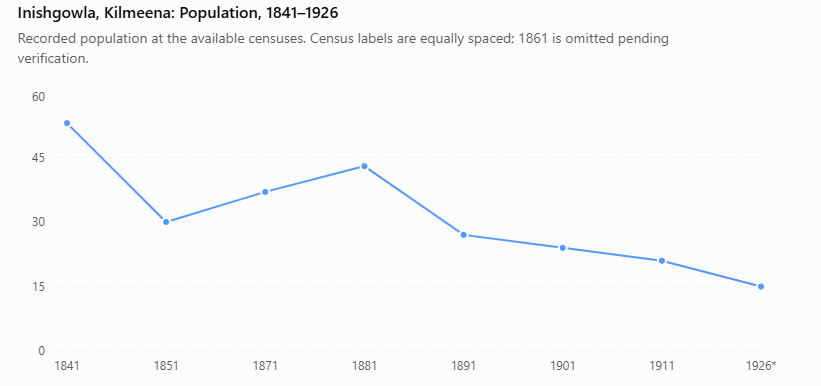
| Census year | Recorded inhabitants |
|---|---|
| 1841 | 53 |
| 1851 | 30 |
| 1871 | 37 |
| 1881 | 43 |
| 1891 | 27 |
| 1901 | 24 |
| 1911 | 21 |
| 1926* | 15 |
The 1926 figure represents named people in the extracts assembled for this research. Their completeness remains to be confirmed. The 1861 figure is omitted pending verification.
Between 1841 and 1851, the recorded population fell from fifty-three to thirty—a reduction of approximately 43% during the Famine decade.
The figures do not tell us how much of that decline resulted from deaths, emigration or movement elsewhere. They do, however, show the scale of the change.
There was subsequently a recovery. Thirty-seven inhabitants were recorded in 1871 and forty-three in 1881. By 1891, the population had fallen again, to twenty-seven.
The later census transcriptions contain twenty-four people in 1901, twenty-one in 1911 and fifteen in 1926. Across those supplied records, that represents a decline of 37.5% over twenty-five years.
Inishgowla’s history was therefore not a straightforward progression towards abandonment. Numbers recovered at times, households changed, and families continued raising children.
The families in the census
Four surnames account for everyone in the supplied 1901 and 1911 transcriptions: Gill, Golden, Staunton and Fadden.
| Surname | 1901 | 1911 | 1926 extract |
|---|---|---|---|
| Gill | 7 | 9 | 8 |
| Golden | 11 | 7 | 0 |
| Staunton | 5 | 3 | 5 |
| Fadden | 1 | 2 | 0 |
| O’Halloran | 0 | 0 | 1 |
| Lally | 0 | 0 | 1 |
| Total | 24 | 21 | 15 |
The table reveals both continuity and substantial change. However, despite the census records, it would appear that these families actually resided on Inishgowla South.
The Gills remained represented across all three censuses. So did the Stauntons. The Golden surname, which accounted for almost half the island’s recorded inhabitants in 1901, was absent from the supplied 1926 extract.
O’Halloran and Lally appeared in that later record, reminding us that the community was not simply losing people. Its composition was changing too.
The Goldens: A substantial family presence
In 1901, eleven Goldens were recorded on Inishgowla:
Patrick, aged fifty-seven; Margaret, forty-eight; Bridget, nineteen; James, eighteen; Edward, sixteen; Catherine, fourteen; William, twelve; Margaret, ten; Michael, nine; Annie, seven; and Austin, six.
Six of those eleven were children under fifteen.
By 1911, seven Goldens appeared: Patrick, Margaret, William, Margaret, Michael, Anne and Austin. The names and ages suggest continuity with the earlier group, although the original household returns are needed to confirm individual relationships.
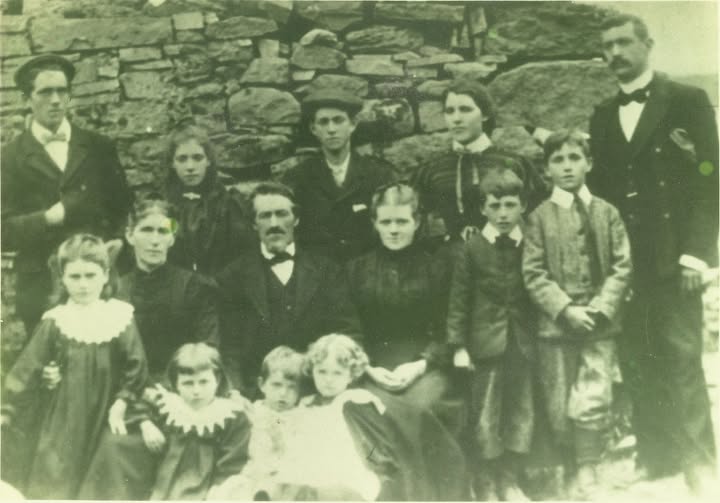
The Golden family on Inishgowla in the summer of 1900 in front of the Golden cottage. Top row standing, left to right–James Golden, Katie Golden (Garland), Edward Golden, Bridget Golden (became Sr. Winifred), Eneas McDonnell; second row seated and standing, Maggie Golden (O’Malley), Margaret (Gibbons) Golden, Patrick Golden, Catherine Malloy, Michael Golden, Willie Golden; bottom row seated, Annie Golden (Gill), Austie Golden, and Nellie McDonnell (Gallagher). Photograph from Brendan Lee.
No Golden appears in the supplied 1926 extract.
That absence presents one of the most important questions in Inishgowla’s history: where did the Golden family go?
A descendant’s account supplied for this research recalls that many Goldens moved to Cleveland. This provides a valuable direction for investigation, but it does not establish when each person left or whether every Golden missing from the later return emigrated.
Deaths, marriage, moves to the mainland and absence on census night must also be considered.
The Gills: Names across generations
The Gill entries offer several promising threads through the three censuses.
William Gill was recorded as thirty-eight in 1901, forty-seven in 1911 and sixty-one in 1926. Peter Gill appeared as thirty-six, forty-five and fifty-eight.
These are plausible age progressions for the same individuals. If confirmed, they would trace two men remaining associated with the island over a quarter of a century.
Other entries show a younger generation. In 1911, the Gill names included Catherine, aged six, Thomas, aged four, and Patrick, aged one. The 1926 extract included Patrick, sixteen, Brigid, thirteen, and Mary Ellen, eleven, alongside older Gill residents.
There are also problems that prevent us from treating every apparent match as certain.
Bridget Gill was recorded as ninety-two in both 1901 and 1911. If the entries concern the same woman, both ages cannot be correct. The discrepancy could reflect an incorrectly reported age, a transcription error or confusion between people sharing a name.
Such inconsistencies are reasons to return to the original documents. They should not be used to make assumptions about the islanders themselves.
Children remained part of island life
Inishgowla’s age profile offers an important contrast with Islandmore and Knockycahillaun.
| Age measure | 1901 | 1911 | 1926 extract |
|---|---|---|---|
| Recorded inhabitants | 24 | 21 | 15 |
| Children under fifteen | 7 | 5 | At least 5 |
| Children under five | 0 | 2 | 3 |
| People whose ages are unavailable | 0 | 0 | 2 |
By 1926, no child under fifteen appeared in the assembled records for Islandmore or Knockycahillaun. On Inishgowla at least five did.
Three were especially young: Mary Staunton, aged three, Joseph Staunton, aged one, and Thomas Martin Staunton, recorded as an infant.
Their presence matters. It shows that population decline did not necessarily mean the immediate disappearance of young families.
Inishgowla still contained children beginning their lives alongside older inhabitants whose experiences reached back into the nineteenth century.
The fifteen names recorded in 1926
The assembled extract preserves the following residents:
| Surname | Names and recorded ages |
|---|---|
| Staunton | Thomas (41), Brigid Agnes (31), Mary (3), Joseph (1), Thomas Martin (0) |
| Gill | William (61), Peter (58), Patrick (71), Thomas (age unavailable), Patrick (16), Brigid (13), Mary Ellen (11), Margaret (age unavailable) |
| O’Halloran | Mary (15) |
| Lally | Catherine (84) |
The oldest person with a supplied age was Catherine Lally, eighty-four. The youngest was Thomas Martin Staunton.
Thomas Staunton provides another possible connection across the censuses. A Thomas was seventeen in 1901, twenty-six in 1911 and forty-one in 1926. That progression makes him a strong candidate for further investigation, although his identity and relationships require confirmation from household and civil records.
The names alone cannot tell us precisely how these people shared their homes. They nevertheless preserve a community containing several generations.
From Inishgowla to Cleveland
The descendants’ accounts extend the story beyond the census.
One contributor researching the Gill, Staunton, Golden and Fadden families identified their great-grandfather as John Gill, reportedly born on Inishgowla South around 1860.
His wife, Bridget Stanton, was said to have been born on the island around the same time. According to the family account, both moved to Cleveland in the early 1880s.
The same contributor recalled Golden and Fadden migration to Cleveland and continuing family connections around Westport.
Taken together, these memories suggest that Cleveland became an important destination for people with Inishgowla roots. Earlier emigrants may have helped relatives and neighbours establish themselves there, although the details of those connections remain to be documented.
The variation between Stanton and Staunton also deserves attention. Both spellings occur in the material associated with these families. They should be searched together during genealogical research, without assuming that every person bearing either spelling belonged to the same line.
The contributor also identified Margaret Staunton Meaney, who reportedly died in 2017, as one of the last island-born members of the family to leave Inishgowla. Her story offers a potential link between the census community and living memory, although the details require documentary confirmation.
“You are not our people”
One particularly memorable detail concerns the Gill surname.
The contributor reported that Islandmore Gills in Cleveland regarded the Inishgowla (or Inishgowla South) Gills as a different family, recalling the words: “You are not our people.”
It is a striking piece of family memory. Even far from Clew Bay, people retained a distinction between Gill families associated with different islands.
It does not prove that the lines shared no ancestry. What it preserves is a sense of separate family identity—an important caution against joining people together solely because they shared a surname.
To descendants, knowing which island a family came from could matter as much as knowing the name itself.
What remained beyond the population figures
Inishgowla’s story encompasses a coastguard establishment, changing island households and family connections reaching across the Atlantic.
The Golden presence diminished and disappeared from the supplied later extract. Gill and Staunton names remained. Young children were still recorded in 1926, while descendants’ memories point towards new lives in Cleveland and continuing connections with Mayo.
The four houses described in 1911 contained more than twenty-one census entries. They contained relationships, memories and the beginnings of histories that would continue elsewhere.
The census records tell us who was there. Descendants’ memories begin to tell us where their lives led.
Does your family have an Inishgowla connection?
Do you recognise any of these names? Did your family include Gills, Goldens, Stauntons, Stantons or Faddens from Inishgowla?
Photographs, letters, family trees, house locations and memories of travelling to the island could help answer the questions the records leave open.
Particularly valuable would be information about the Golden family after 1911, the families who settled in Cleveland, the coastguard buildings, and the people who remained on Inishgowla after 1926.
Please contact [email protected] if you have a connection or something to share.
References
Croagh Patrick and the Islands of Clew Bay
Related Posts
- Islandmore and Knockycahillaun: A Connected Community, Remembered Across Generations
- Who held the deeds to the islands after the famine?
- When the Islanders of Clew Bay Defied Lord Sligo: The Rent Revolt of 1887
- The Forgotten Communities of Northern Clew Bay
- The Disappearing Island Communities of Clew Bay: 1901–1926
- The Islands and Maritime History of Westport Bay
- Where did the people of Newport Bay’s Islands go?
- Inishlyre – The Clew Bay Island that welcomed the world