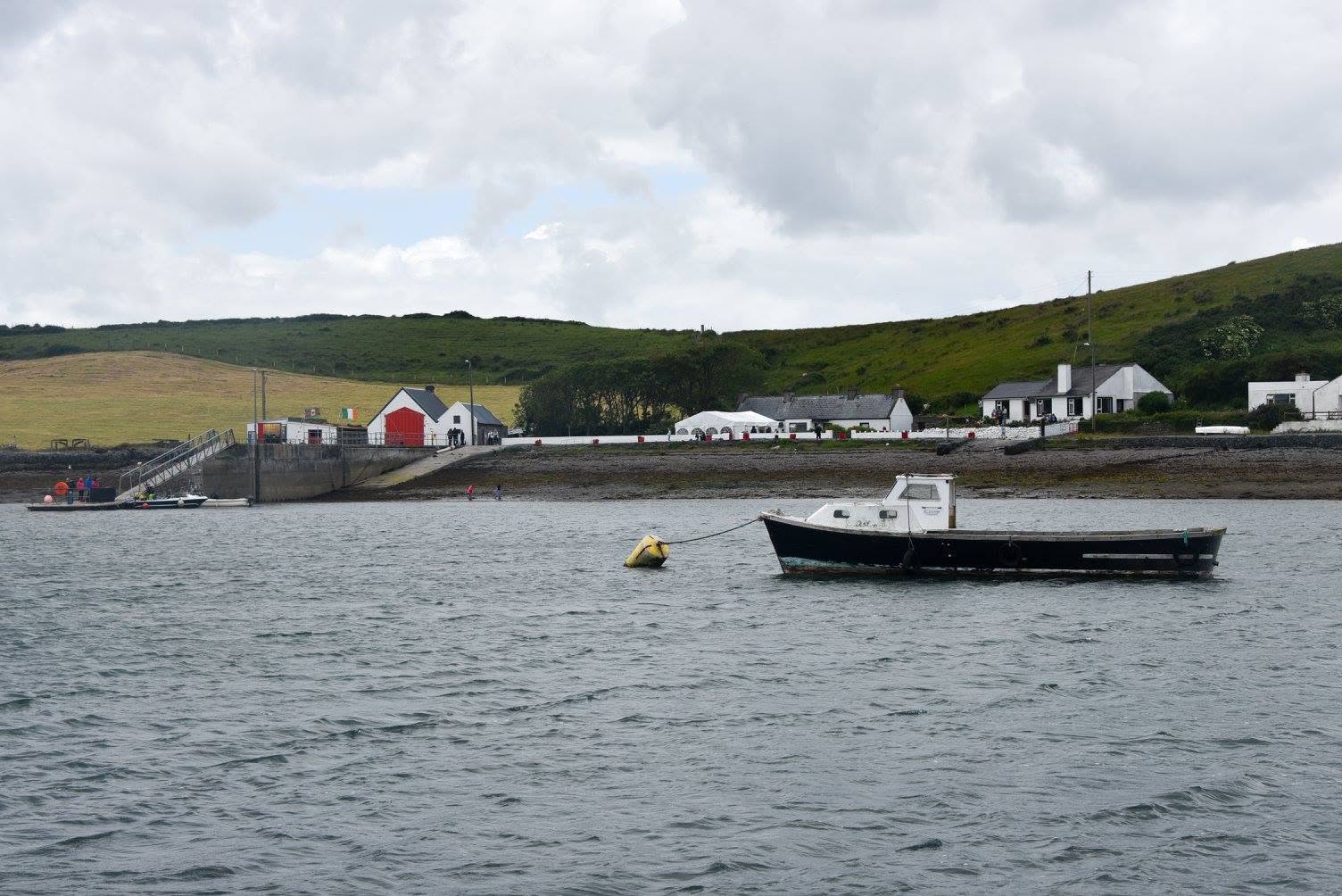
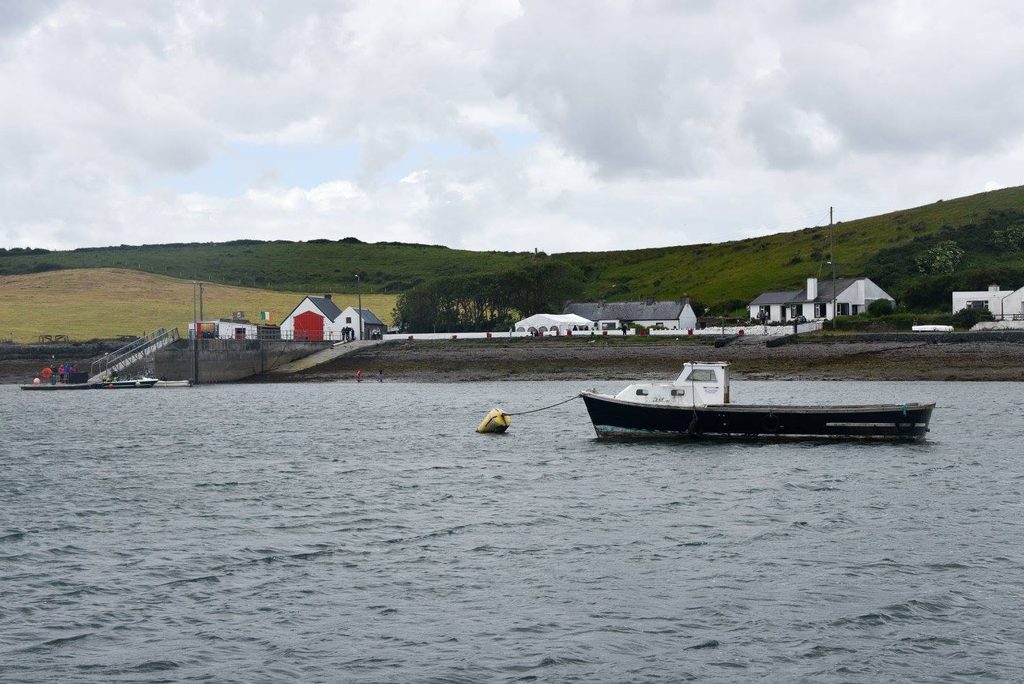
Today only three people live permanently on Inishlyre. Yet this small island in Clew Bay once had more than a hundred inhabitants, a thriving maritime community, pubs, cargo traffic, a lifeboat station and a natural harbour important enough to feature in one of the most dramatic episodes of the Irish Civil War.
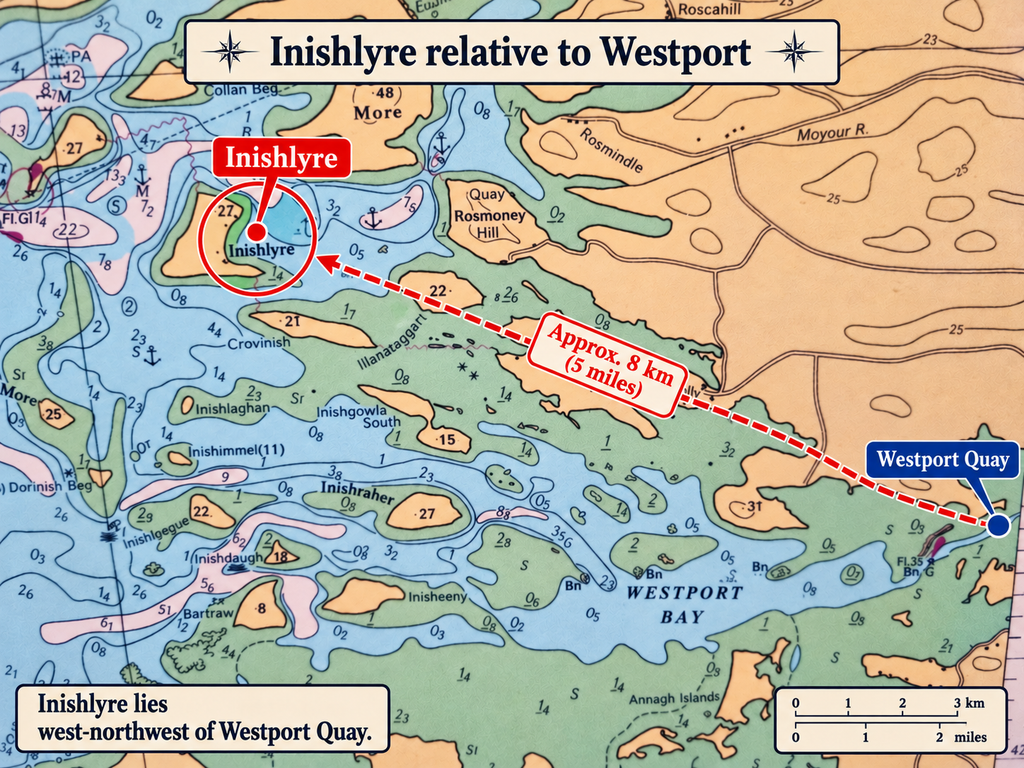
Seen from Croagh Patrick, Inishlyre is visible among the extraordinary scatter of islands that fills the inner reaches of Clew Bay. It covers about 55 acres and lies roughly eight kilometres west-northwest of Westport.
Yet its size is misleading. For much of the nineteenth century, Inishlyre occupied an important position between Westport and the Atlantic world.
A natural harbour
The key to the island’s importance was its harbour.
Westport itself did not have a deep-water harbour capable of accommodating larger vessels. Ships could therefore discharge cargo at Inishlyre, where goods were transferred into smaller boats and carried onwards to the mainland.
In the nineteenth century, the island had two pubs, while my original research for Croagh Patrick and the Islands of Clew Bay also recorded a hotel and accounts of large ocean-going vessels using the deep anchorage.
The possibility of developing Inishlyre as a port of call for ocean-going vessels was even considered, although the project never developed into the transport connection that might have transformed the island’s future.
That maritime importance is reflected in something almost forgotten today: Westport’s first lifeboat station was actually on Inishlyre.
Westport’s lifeboat — on an island
In 1857, the RNLI established a lifeboat station on Inishlyre. A 28-foot self-righting pulling-and-sailing lifeboat was sent to the island. It had sails and ten oars and was intended to assist vessels approaching the port. A purpose-built boathouse was constructed beside the small jetty.
The boat itself had an extraordinary history. Named the Clifton, it had previously served at Lytham in Lancashire. In 1852 it had capsized during an exercise in which eight crewmen lost their lives.
The lifeboat was transported from Liverpool to Westport free of charge by the proprietor of the Liverpool–Westport steamship service.
The Inishlyre station operated for only five years and closed in 1862, but the old lifeboat house still survives beside the jetty. That single building is a reminder that Inishlyre was once considered a strategically important point on the maritime approaches to Westport.
More than a hundred islanders
The population figures tell an equally striking story.
In 1841, 113 people lived on Inishlyre. The population actually reached 122 in 1851, living in 17 houses. It subsequently fell sharply, although numbers fluctuated considerably during the remainder of the nineteenth century.
By 1901 the population had fallen dramatically, and by the early twentieth century only a handful of households remained. The 1926 census recorded just 21 people in three households.
And one surname overwhelmingly dominated the island. Twenty of those 21 inhabitants were Gibbonses. The remaining resident was recorded as Gillespie.
That family connection is particularly significant because it did not disappear with the old census books.
The Gibbons families
The Gibbons name remained synonymous with Inishlyre well into modern times.
An old account used in the foreword to the book remembers three Gibbons families living on Inishlyre, part of a network of island families who knew one another across Clew Bay.
By 1999, RTÉ found John Gibbons still living on Inishlyre and working as the postman serving the inhabited Clew Bay islands. Joachim Gibbons and his partner Rhoda Twombly were also living there and operating a freight-shipping business.
At the time, Joachim and Rhoda were building what RTÉ described as the first new house on Inishlyre for a century. The islanders were still depending on generators for electricity and campaigning for better services.
A later Irish Times account paints a wonderfully intimate picture of island life. Four occupied houses stood along the shore facing the pier. John Gibbons lived at the western end. Joachim and Rhoda occupied another; Sheila, who had been born and raised on the island, had returned after ten years in New York; her brother Tom lived nearby.
Shopping meant taking a boat to the mainland, where cars were kept at the pier. Bad weather could make leaving the island impossible. The island’s own primary school had already closed.
And that family connection has survived into the present day.
In March 2026, an HSE report on healthcare for island communities identified Sheila Keeley and Rhoda Twombly as residents of Inishlyre.
The 2022 census recorded only three permanent residents on the island. From more than a hundred people to three — yet the island has never been abandoned.
The day an army arrived
Perhaps the most extraordinary episode in Inishlyre’s modern history came during the Irish Civil War.
On 24 July 1922, the former cross-channel ferry SS Minerva arrived in Clew Bay after sailing from Dublin around the Irish coast. She had been converted into a National Army troop carrier.
On board were approximately 400 soldiers, together with an 18-pounder artillery piece, some 600 rifles, 150 bicycles, and a Rolls-Royce armoured car armed with a Vickers machine gun.
The Minerva anchored off Inishlyre. From there, National Army forces moved against positions around Westport. A force landed at Rosmoney and the main body subsequently reached Westport Quay.
For a few hours, this tiny island off the Mayo coast found itself on the edge of a major military operation.
Plans for a Railway
Inishlyre was considered so strategically important to the west that in the early 1900’s there were even proposals to connect the Inishlyre anchorage directly to the Irish railway network. Plans survive for a railhead known as “Inishlyre Roads,” apparently intended for the mainland shore opposite the island – most likely at Rosmoney, where passengers and cargo from deep-water vessels could have transferred ashore and continued by train to the main Achill-Westport line (today known as the Great Western Greenway). The scheme was never realised as Midland Great Western Railway withdrew their support.
Shipwrecks beneath the surrounding waters
Inishlyre’s maritime history was not always prosperous. The waters around the island contain the remains of several wrecks.
In 1899 the wooden sloop Flora of Westport was lost after being struck by another vessel during a severe gale. In 1904 the Pearl caught fire and burned in Inishlyre harbour.
Then in 1928, the 200-ton ketch Charles Stewart Parnell, which carried coal and supplies for lighthouses, caught fire and sank nearby.
And that wreck produced one of the more peculiar legends of Clew Bay. Local scuba divers say that an enormous lobster lives inside the ship’s boiler. According to the story, the lobster entered when small, grew over the years and eventually became too large to get back out.
Life connected by water
For generations, water was not something separating Inishlyre from its neighbours. It was the road connecting them.
Children could be rowed between islands for school. Goods moved from vessel to vessel. Fishermen, pilots, postmen and traders travelled through channels that outsiders might regard as barriers.
Even late in the twentieth century, the post was still delivered by boat.
The man who had been the island postman for roughly 30 years was Sean Jeffers of Inishgort. When Sean retired in 1998, the Irish Times reported that John Gibbons of Inishlyre took over, making the rounds three times a week to about 15 houses across seven populated islands.
Tommy Gibbons also later worked the postal route. He was born in 1958, lived all his life on Inishlyre, and by the 2000s was delivering post to the inner-bay islands as well as working as a ferryman, farmer, fisherman, and caretaker of Inishgort lighthouse. He died in 2009.
It is difficult to think of a better illustration of how different life in the bay could be from life only a few miles away in Westport.
An island that endured
Inishlyre’s story is not simply one of population decline. It is a story of continuity.
The harbour that once accommodated commercial vessels is still there. The old lifeboat house survives. The Gibbons family remained connected with the island across generations. Island residents continued travelling the same waters their grandparents and great-grandparents knew.
And despite emigration, storms, isolation, declining population and the closure of services, Inishlyre remains inhabited.
The 113 people recorded there before the Famine have become three, but the island is not empty.
And perhaps that is the most remarkable part of its story.
Do you have photographs, family memories or stories connected with Inishlyre?
I would be delighted to hear from anyone whose family lived on the island, travelled there, worked the harbour or remembers the Gibbons families.
Enjoyed this story?
Inishlyre is one of dozens of fascinating places explored in Croagh Patrick and the Islands of Clew Bay: A Guide to the Edge of Europe. Over 1,000 copies sold to date.
Next Post – The Wrecks of Clew Bay