In 1841, Islandmore and Knockycahillaun supported 129 inhabitants between them. By 1911, forty-three people occupied eight houses. The census extracts assembled for 1926 contain just twenty-six names—and not one belongs to a child younger than fifteen.
Those figures tell a story of declining population and changing households. But descendants’ memories reveal something more: families who left for Liverpool, Cleveland and Kilkenny continued to regard this connected corner of Clew Bay as home.
Two names, one connected place
Islandmore and Knockycahillaun are joined by land, although they retain separate historical townland identities. This explains why their inhabitants were counted separately in census returns and their holdings recorded separately in Griffith’s Valuation. Considered together, they offer a fuller picture of a closely connected community.
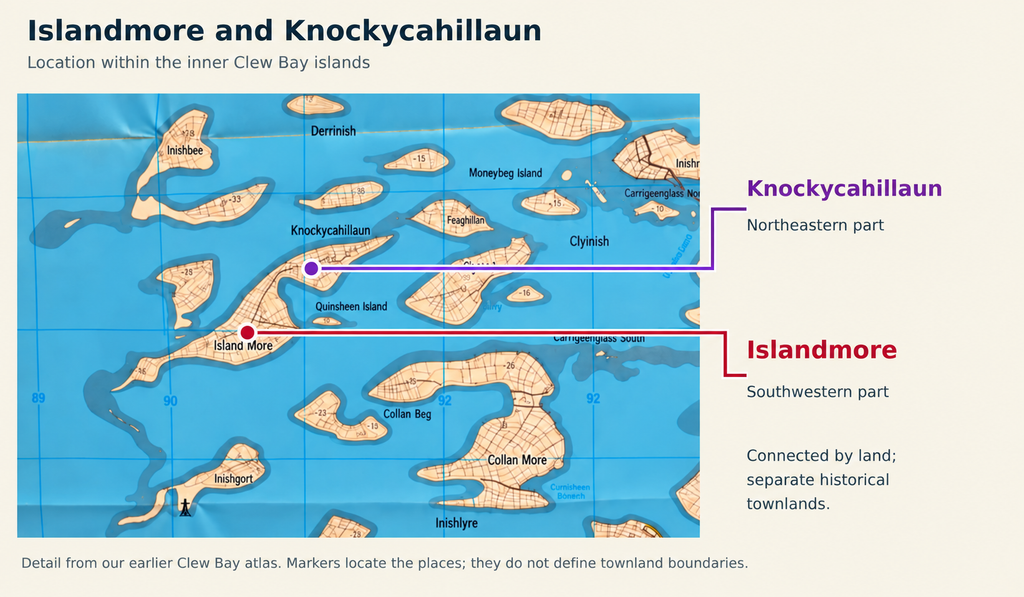
Knockycahillaun was sometimes referred to by islanders as “Naka Cahalen”, a phonetic rendering preserved in family recollection.
One descendant described her grandfather Tony Gill as coming from “Knockycahillaun/Islandmore”. The overlapping names reflect how the place was remembered within families, even where official records maintained a boundary.
Location detail from the earlier Clew Bay atlas. The markers identify the two places rather than their exact townland boundaries.
A population decline that was not uninterrupted
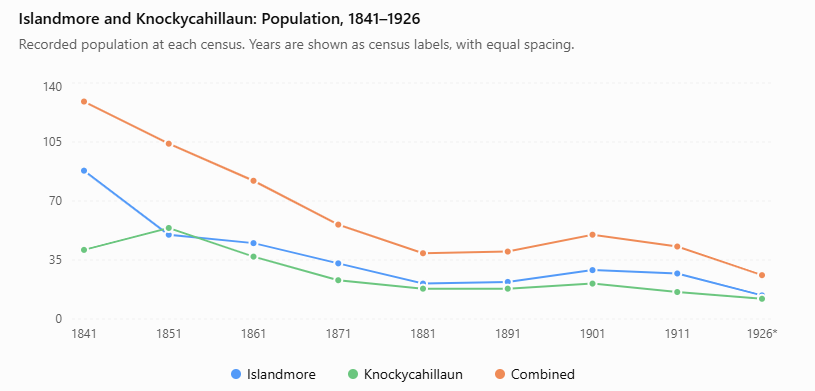
The census figures assembled so far trace the changing population across the two townlands:
| Year | Islandmore | Knockycahillaun | Combined |
|---|---|---|---|
| 1841 | 88 | 41 | 129 |
| 1851 | 50 | 54 | 104 |
| 1861 | 45 | 37 | 82 |
| 1871 | 33 | 23 | 56 |
| 1881 | 21 | 18 | 39 |
| 1891 | 22 | 18 | 40 |
| 1901 | 29 | 21 | 50 |
| 1911 | 27 | 16 | 43 |
| 1926* | 14 | 12 | 26 |
The 1926 figures represent named people in the extracts assembled for this research. Their completeness remains to be confirmed.
The graph shows a long decline, but not a continuous one. In 1841, Islandmore and Knockycahillaun supported 129 people between them. By 1881, only thirty-nine remained—a fall of almost 70% in forty years.
Their experiences during the Famine decade differed. Islandmore’s population fell from eighty-eight to fifty, while Knockycahillaun’s rose from forty-one to fifty-four. That increase raises the possibility of movement between neighbouring communities, but the figures alone cannot establish what happened. Across the two townlands, the population declined by twenty-five.
There was also a modest recovery towards the end of the century. The combined population rose from thirty-nine in 1881 to fifty in 1901, before falling to forty-three in 1911. These were communities that continued to sustain families through considerable change.
The supplied 1926 extracts contain twenty-six names, approximately one-fifth of the combined 1841 population, although their completeness remains to be confirmed. More revealing than the total is the changing age profile: twenty-two residents were under fifteen in 1901, ten in 1911, and none in the assembled 1926 records.
The story, therefore, concerns more than diminishing numbers. It is also about households growing older and fewer young children appearing in the records. The descendants’ accounts add the other side of that change: families established lives elsewhere while retaining ties to Islandmore and Knockycahillaun.
Landholding and the Gill connection
The Griffith’s analysis, recorded as 1855 in the research compilation, identifies the following lessees or occupiers. These are most likely the heads of households and do not reflect other family members at the time:
| Record | Islandmore | Knockycahillaun |
|---|---|---|
| Named occupiers | Mary Gill; Richard Gill; James Gill, appearing three times; Thomas Gill, appearing twice; John Gill | Michael Kelly; Richard Gill Jr; Richard Gill Snr |
| Immediate lessor | Marquis of Sligo | Law Life Assurance Company |
| Houses recorded | 6 | 3 |
The repeated Gill entries on Islandmore should not automatically be counted as separate individuals or households. A person might appear against several holdings, while different people could share the same name. The original valuation pages and map references are needed to resolve those distinctions.
Nevertheless, the records establish a strong Gill association with Islandmore by the middle of the nineteenth century. The nearby Quinsheen entries also name Mary, Richard, James, Thomas and John Gill, suggesting a wider pattern of land use around the neighbouring islands.
Families and houses
By 1901, Islandmore’s twenty-nine recorded residents comprised seventeen Kellys, six O’Malleys, five Gills and Catherine McHale.
Knockycahillaun’s twenty-one entries included sixteen Gills, three Kellys, Mary Moore and Michael Gavin. Two separate entries name a Joseph Gill aged nine; these require checking against the original return to establish whether they represent different children or a duplicated transcription.
According to the book Croagh Patrick and the Islands of Clew Bay, Islandmore’s twenty-seven inhabitants in 1911 occupied four houses, each containing only two rooms. That meant twenty-seven people sharing eight rooms, although the occupancy of individual houses would have varied.
Knockycahillaun also had four inhabited houses, accommodating sixteen people. Mary Moore lived alone. Joseph Kelly and his wife Ellen shared their home with Mary Gill, identified in the book as a sister-in-law.
The book also describes surviving houses in the sheltered gap between Islandmore and Knockycahillaun, with a laneway through the settlement. That physical setting helps explain why the two townlands make sense as one connected community.
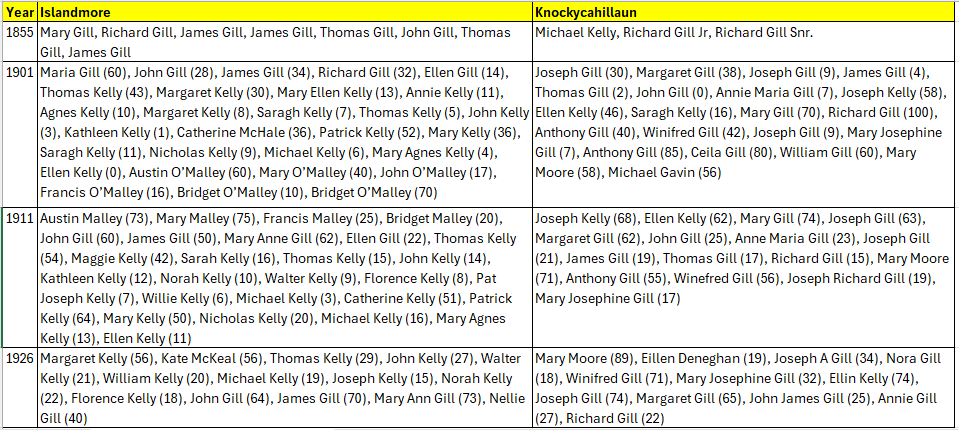
Inhabitants of both islands as recorded in Griffiths Valuation (1855) and Census records of 1901, 1911, and 1926:
Communities without young children
Perhaps the most striking Census finding concerns children.
| Residents under fifteen | 1901 | 1911 | 1926 extracts |
|---|---|---|---|
| Islandmore | 15 | 10 | 0 |
| Knockycahillaun | 7 | 0 | 0 |
| Combined | 22 | 10 | 0 |
In 1901, twenty-two of the fifty recorded inhabitants were under fifteen. By 1911, that number had fallen to ten, all on Islandmore. Knockycahillaun already had no recorded resident younger than fifteen.
By 1926, none of the twenty-six people in the assembled extracts was under fifteen.
Islandmore’s youngest recorded inhabitant was Joseph Kelly, aged fifteen. Other Kelly residents included Thomas, John, Walter, William, Michael, Norah and Florence: young adults and older teenagers, but no small children.
Among Islandmore’s older inhabitants were John Gill, sixty-four, James Gill, seventy, and Mary Ann Gill, seventy-three.
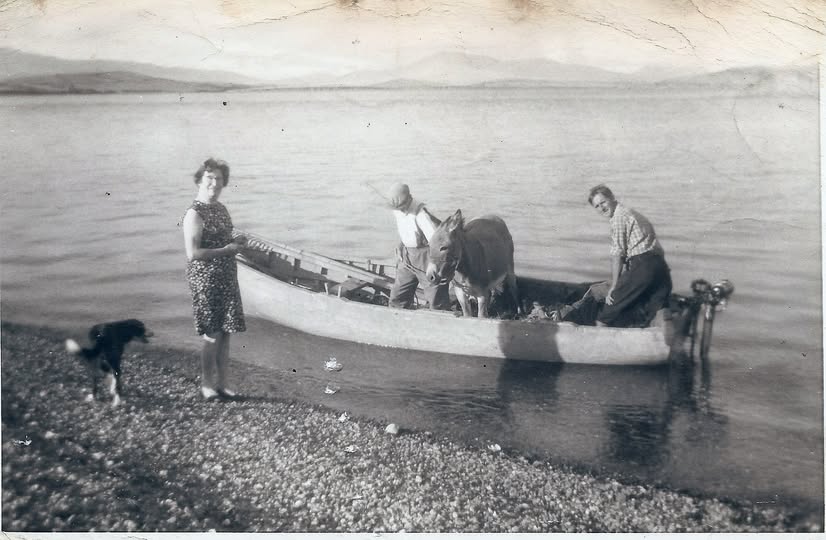
This photo from Dhara Kelly shows Florrie Kelly of Islandmore, and Martin and Sean Jeffers, Inisgort
On Knockycahillaun, Nora Gill, eighteen, was the youngest person recorded. Mary Moore was listed as eighty-nine. Joseph Gill and Ellin Kelly were both seventy-four, Winifred Gill was seventy-one, and Margaret Gill was sixty-five.
These figures do not prove that the community was about to disappear. They do show a marked change in its age structure. Working-age people remained, but young children were absent from the records assembled so far.
Foreign ships, a Turkish coin and the island pilots
Islandmore’s connections extended beyond its emigrant families. As Dan MacCarthy recounted in the Irish Examiner, Tommy Gibbons found a coin on its beach in 1957. Identified by the National Museum in 1992, it was an Ottoman ten-para piece dating from the reign of Sultan Abdülmecid I, 1839–1861.
One suggested explanation was that foreign sailors visiting Westport collected ballast from the island’s shores before their outward voyages. The coin offers an intriguing connection with that maritime world, although how it reached the beach remains uncertain.
Islanders also helped ships navigate the bay. Josie Gill of Islandmore worked as a pilot, along with Tommy Gibbons of Inishlyre and Peter Hopkins of Rosbeg, guiding vessels through its difficult channels towards Westport. The Clew Bay Heritage Centre holds a plaster portrait of him by sculptor Helen Hooker O’Malley Roelofs. Another island-born pilot, Dick Gill, who died in 2020, was described as the last of the Newport Bay pilots. Earlier pilots included William Gibbons and Patrick Hopkins (1915).
Agnes Kelly: From Islandmore to Kilkenny
Individual lives reveal what lay beyond those changing totals.
Agnes Kelly appears in the 1901 Islandmore transcription as a ten-year-old. The family history supplied for this research identifies her as a daughter of Thomas Kelly and Margaret McHale and remembers her as a midwife who served the island communities.
According to that account, Agnes married Richard Ryan, a Post Office clerk from County Kilkenny, in December 1910. Richard later joined the Royal Engineers and served in Mesopotamia during the First World War, working in military signals and telegraphy.
Their marriage was tragically short. In the autumn of 1918, their infant daughter Mary Angela died during the influenza epidemic. Richard died of influenza and pneumonia only days later, on 6 November, two days before his thirty-third birthday.
Agnes was left a young widow with small children. Her family records that she returned to Kilkenny, where she later established St Philomena’s Nursing Home, subsequently known as Lacken House. Her sons went on to establish professional and business careers in Kilkenny.
Yet the Islandmore connection survived. Descendants say the family still maintains a holiday home there, without electricity—a detail recalled with amusement because one of Agnes’s descendants became an electrician.
These details remain a family account awaiting independent documentary confirmation. They provide a valuable thread connecting a child’s name in the island census with a much wider life.
The Gills: Emigration, refuge and return
Gill descendants preserve another part of the story.
Shelagh McLaughlin recalls that her mother’s family were Gills from Islandmore and that her grandfather was a first cousin of Josie Gill. As a child, she accompanied her mother on visits to Josie when they returned from England.
During the Second World War, that connection offered refuge. According to Shelagh, her grandfather brought her mother Alma and Alma’s brother Tony from Liverpool to Islandmore, where they stayed until the war ended.
Alma remembered her time there with affection. Her daughter believes she would have returned permanently if circumstances had allowed.
Here, movement ran in the opposite direction to the familiar story of emigration: children came from an English city to safety among their island relatives.
Gemma Brain also identifies her grandfather as Tony Gill of Knockycahillaun/Islandmore. Whether he was the Tony mentioned in Shelagh’s account remains to be established.
Brendan Gill offers a particularly direct link with the earlier community. Writing at ninety-one, he stated that his father, John Gill, was born in 1891 on Islandmore—or, more precisely, “Naka Cahalen”— and emigrated in 1921. His account preserves both a family departure and a local name.
Other testimony points to Islandmore Gills in Cleveland. A researcher into the Inishgowla Gills reported that the Islandmore families there regarded themselves as a different Gill line. This is a useful reminder that sharing a surname on neighbouring islands does not establish a family relationship. The remembered distinction is a research lead, rather than proof that the families had no common ancestry.
What the figures cannot show
The census records preserve names, ages and diminishing totals. The housing descriptions place those people in small dwellings clustered around a sheltered settlement.
Family recollections add what those records cannot: a young widow establishing a new life in Kilkenny, children finding refuge from wartime Liverpool, emigrants remembering “Naka Cahalen”, and descendants returning to houses associated with their grandparents and great-grandparents.
Islandmore and Knockycahillaun remained separate townlands on paper while forming a connected place in family memory. Their population diminished, but their connections extended far beyond Clew Bay.
Their people carried the islands with them.
Sources and research notes
This account draws on the compiled census research for 1841–1926, Griffith’s Valuation extracts, Croagh Patrick and the Islands of Clew Bay, and family history supplied by descendants.
Secure checkout powered by WooPayments. Payment details are processed securely and are not stored on The Reek website.
Related Posts
- Inishgowla: An Island Community remembered from Clew Bay to Cleveland
- Who held the deeds to the islands after the famine?
- When the Islanders of Clew Bay Defied Lord Sligo: The Rent Revolt of 1887
- The Forgotten Communities of Northern Clew Bay
- The Disappearing Island Communities of Clew Bay: 1901–1926
- The Islands and Maritime History of Westport Bay
- Where did the people of Newport Bay’s Islands go?
- Inishlyre – The Clew Bay Island that welcomed the world