How the islands of Clew Bay were divided among aristocratic families, wealthy landowners, local proprietors and even a London insurance company in the aftermath of the Great Famine.
Today, most of the islands of Clew Bay are generally associated with their former inhabitants, deserted cottages, abandoned fields and the gradual disappearance of once-thriving communities.
But who owned the deeds to the islands on which these families lived?
The principal landowners of the Clew Bay Islands in the 1850s

1. The Marquess of Sligo – Browne family
43 recorded islands
The Brownes accumulated extensive property through inheritance, land settlements and purchases. George John Browne was the 3rd Marquess during Griffith’s Valuation.
By 1876, the family held approximately 114,881 acres in Mayo. Its Clew Bay holdings included Islandmore, Inishlyre (along with the Gibbons family, John Walsh and Michael Heraghty parcels), Clynish, Dorinish and Inishgowla South.
What remains unknown: The precise acquisition histories of many individual islands.
2. Henry J. Smith junior — Newfield estate
24 recorded islands
Henry Jeremiah Smith’s family was established at Beabeg and Annesbrook in County Meath. He acquired the Newfield estate near Newport following the sale of the McLoughlin estate in 1850.
His recorded island holdings included Moynish More, Moynish Beg, Inishbobunnan, Inishcannon, Inishcorky and Inishquirk.
In 1861, Smith’s estate of approximately 8,277 acres at Newfield was advertised for sale. By 1876, much of the property belonged to the Gibbings family.
What remains unknown: Which generation of Henry Jeremiah Smith corresponds to junior in the valuation, and which islands were included in the 1861 sale.
3. Law Life Assurance Society
13 recorded islands
The Law Life Assurance Society acquired Mayo property formerly belonging to Sir Samuel O’Malley of Kilboyne following the financial difficulties of his estate.
Its island interests included Inishcottle, Inishgort, Inishnakillew, Knockycahillaun, Collan Beg and Collan More.
The company had acquired its Irish property by 1852. Parliamentary proceedings in 1864 examined ejectment cases brought by the society, although there were disputes over how many resulted in actual evictions.

4. Sir William Roger Palmer
10 recorded islands
The Palmer family’s western estates derived partly from seventeenth-century land grants, supplemented by inheritance and purchases.
Their holdings in Mayo exceeded 80,000 acres by 1876. The Clew Bay records associate them with islands such as Muckinish, Roslynagh, Inishdaweel, Gobfadda and Kid Island East.
John S. Buchanan repeatedly appears as lessee, suggesting he held a group of islands under the Palmer estate.
What remains unknown: Buchanan’s precise role and how the individual islands were acquired.

5. Sir Richard O’Donel — Newport family
4 recorded islands
The O’Donels were an established Mayo landed family. In 1785, Sir Neal O’Donel acquired the Medlycott family’s leasehold interest in the Manor of Burrishoole.
Sir Richard appears in the valuation in connection with Rabbit Island near Newport, Rosbarnagh, Rosmore and Sixpenny Island.
Financial difficulties led to substantial estate sales during the early 1850s, although the family retained property in the region.
What remains unknown: The original acquisition arrangements for these particular islands and the relationship, if any, between Sir Richard and Judith O’Donnell, who appears separately with seven island entries.
Griffiths Valuation
Griffith’s Valuation, compiled in County Mayo during the 1850s, provides a revealing picture of landownership in the bay during one of the most turbulent periods in Irish history.
Here is an example of what were considered the most valuable islands in the bay, according to Griffiths, along with their landlords and lessees:
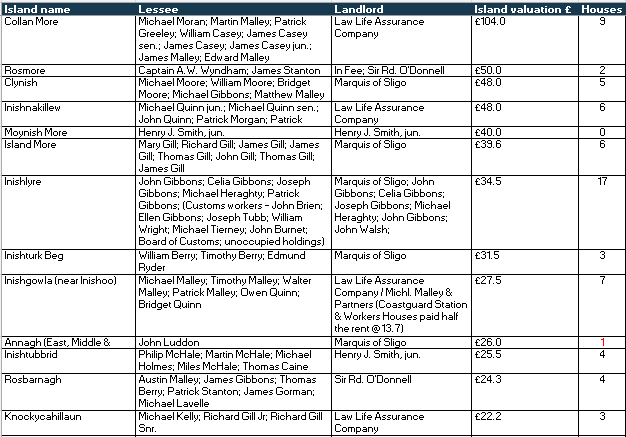
This covers 140 island and island-group entries, identifying a remarkable collection of proprietors and landlords. The valuation appears to reflect the yearly rent of the island that lessees had to pay at the time. There were a couple of exceptions – for example the coastguard station on Inishgowla in the Kilmeena district of the bay (not the Inishgowla in Burrishoole) paid half of the yearly rent. Also six customs workers were housed on Inishlyre and would also have contributed to the rent. Some landlords (such as Henry J. Smith junior) were also listed as occupiers, so obviously paid no rent.
Among them were the Marquess of Sligo of Westport House, Henry Jeremiah Smith of County Meath, the Palmer family of County Dublin, the O’Donels of Newport and, perhaps most surprisingly, the Law Life Assurance Society of London.
Smaller proprietors included Captain A. W. Wyndham, William B. Stoney, John C. Garvey, John Luddon and Nathaniel P. Simes.
The records reveal that the islands were far from being the exclusive property of the great Westport estate. They were divided among several powerful landholding interests, often involving people who lived considerable distances from Clew Bay.
What Griffith’s Valuation reveals
Griffith’s Valuation was a nationwide assessment of land and buildings carried out between 1847 and 1864.
For each holding, it recorded the occupier, immediate lessor, acreage, property description and assessed annual value.
In many cases, the occupier was a tenant paying rent to a landlord. In others, the occupier owned the holding directly. Some entries involved intermediate tenants who themselves held property from larger estates.
Consequently, the records must be interpreted with care. A named immediate lessor was not invariably the ultimate freehold owner, and a person recorded as occupying an island did not necessarily reside there.
Nevertheless, when the recorded landlords are considered alongside those holding property in their own right, an unusually detailed picture emerges of the principal landholding interests around Clew Bay.
The principal landholders
The revised research identifies the following distribution of recorded property interests:
| Landholder or landlord | Islands |
|---|---|
| Marquess of Sligo | 43 |
| Henry J. Smith junior | 24 |
| Law Life Assurance Society | 13 |
| Sir William Roger Palmer | 10 |
| Judith O’Donnell | 7 |
| Sir Richard O’Donel | 4 |
| John C. Garvey | 4 |
| Captain A. W. Wyndham | 3 |
| William B. Stoney | 1 |
| John Luddon | 1 |
| Nathaniel P. Simes | 1 |
These figures represent appearances in the valuation register, not necessarily separate islands. Some records concern island groups, and certain holdings involve more than one named party. A further 29 entries have no identifiable landholder in the working register.
One finding stands out immediately: the Marquess of Sligo and Henry J. Smith junior together account for 67 entries – almost half the entire register.
The extent of Smith’s involvement is particularly interesting, because his name is much less familiar in the history of Clew Bay than that of the Browne family of Westport.
The Marquess of Sligo – the largest landholder
The Browne family of Westport House had accumulated extensive estates in County Mayo from the seventeenth century onwards.
Colonel John Browne consolidated the family’s holdings through inheritance, land transactions and the political upheavals of that period. His descendants became Earls of Altamont and, subsequently, Marquesses of Sligo.
During the 1850s the title was held by George John Browne, the 3rd Marquess of Sligo.
The Griffith’s records associate the estate with 43 entries across Clew Bay.
These include holdings on Islandmore, Inishlyre, Clynish, Dorinish, Inishgowla South, Inishoo and many smaller islands.
By 1876, the Sligo estate extended to approximately 114,881 acres in County Mayo, making it the county’s largest landed estate.
The family’s influence over the islands was therefore part of a much wider system of estate ownership, agricultural tenancy and rental income extending across western Mayo.
Yet the island holdings were not necessarily occupied directly by families renting from the Marquess. Some were held under intermediate leases, while others involved smaller properties with several named interests.
Henry Jeremiah Smith – the second-largest recorded landholder
Perhaps the most unexpected discovery is the extent of the holdings associated with Henry J. Smith junior.
His name appears in 24 entries, making him the second most frequently recorded identifiable landholder in the research.
The holdings include Moynish More, Moynish Beg, Inishbobunnan, Inishcannon, Inishcorky, Inishcooa, Inishquirk and several islands around the Newport and Burrishoole parts of the bay.
Smith was associated with the Newfield estate near Newport, formerly held by the McLoughlin family.
The McLoughlins had controlled substantial estates in Burrishoole and Achill, with interests connected to the Medlycotts, O’Donels and Marquesses of Sligo.
Financial difficulties resulted in the estate being offered for sale through the Encumbered Estates Court in 1850.
Henry Jeremiah Smith of Beabeg, County Meath, subsequently acquired the Newfield property.
The fact that so many islands appear under the name Henry J. Smith junior suggests that the family held a substantial collection of island properties rather than merely one or two isolated holdings.
An interesting development followed in 1861, when Henry Jeremiah Smith advertised approximately 8,277 acres of the Newfield estate for sale.
By 1876, much of the former Newfield property was owned by the Gibbings family.
The exact relationship between the individual styled junior in Griffith’s Valuation and the Henry Jeremiah Smith associated with the estate transactions remains to be conclusively established.
Nevertheless, the records raise an important historical question: were these islands acquired together as part of the Newfield estate, and were they subsequently sold as a group?
The Law Life Assurance Society — when an insurance company owned islands
One of the more remarkable names in Griffith’s Valuation is the Law Life Assurance Society.
This London-based financial institution is associated with 13 entries in the Clew Bay register, including Inishcottle, Inishgort, Inishnakillew, Knockycahillaun, Collan Beg, Collan More and several smaller islands.
Its presence can be traced to the financial difficulties of Sir Samuel O’Malley of Kilboyne.
The O’Malley family had held extensive estates in Mayo, including land in Kilmeena and around Clare Island.
Following the Great Famine, significant parts of the estate passed to the Law Life Assurance Society.
This was part of a wider transformation of Irish landownership.
The Encumbered Estates Court, established in 1849, facilitated the sale of heavily indebted estates, often transferring land from established families to new purchasers and financial institutions.
The Law Life Assurance Society’s involvement is particularly interesting because the islands, some of them inhabited by farming and fishing families, had become part of the property portfolio of an institution based in London.
The company subsequently became the subject of parliamentary discussion concerning its management of Irish tenants, including allegations relating to rents and ejectments.
Whether any of the Clew Bay islanders were directly involved in these disputes remains unknown.
However, surviving records from the 1840s, 1850s and 1870s may allow the ownership and occupation of the company’s island properties to be traced over several decades.
Sir William Roger Palmer – an absentee estate owner
Sir William Roger Palmer belonged to the Palmer family of Kenure Park, Rush, County Dublin.
The family had extensive landholdings in western Ireland, originating partly in grants made during the seventeenth century and supplemented by inheritance and purchases.
By 1876, the Palmers owned more than 80,000 acres in County Mayo.
The Griffith’s research associates Palmer with 10 entries in Clew Bay, including Muckinish, Roslynagh, Inishdaweel, Gobfadda, Kid Island East and other small islands.
An especially interesting feature is the repeated appearance of John S. Buchanan as occupier.
Buchanan appears to have held several islands under the Palmer estate.
Whether he used them for grazing, agriculture or subletting is not yet clear, but the pattern suggests a substantial tenancy arrangement rather than separate occupation by a family on each island.
This is an important reminder that not every name associated with an island in Griffith’s Valuation represents a permanent resident.
The Palmer family retained extensive Mayo properties until the twentieth century, when its western estates were sold to the Congested Districts Board.
The O’Donels of Newport
The O’Donel family had long been associated with Newport and Burrishoole.
Originally connected with the wider O’Donnell family, a branch established itself in western Mayo and became an important part of the region’s landed establishment.
One of the family’s most significant property transactions occurred in 1785, when Sir Neal O’Donel acquired the Medlycott family’s leasehold interest in the Manor of Burrishoole.
The transaction reflected the complicated nature of eighteenth-century landholding, in which ownership and long-term leasehold interests could pass between several families.
The Griffith’s register identifies Sir Richard O’Donel in connection with Rabbit Island near Newport, Rosbarnagh, Rosmore and Sixpenny Island.
His four recorded entries represent a relatively modest presence compared with those of the Marquess of Sligo or Henry J. Smith.
However, the wider O’Donel estate had substantial historical interests around Newport, and the family had faced considerable financial difficulties during the nineteenth century.
Parts of its property were sold through the Encumbered Estates Court in the early 1850s.
Judith O’Donnell — seven islands and an unresolved identity
One of the more intriguing names in the entire register is Judith O’Donnell.
She appears in seven entries associated with Inishcuill, Inishcuill West, Inishdaff, Inishfesh, Inishloy, Inishmolt and Taash Island.
Unlike the well-documented aristocratic families, Judith’s identity remains uncertain.
She may have been connected with the Newport O’Donels, but the relationship has not yet been established.
The concentration of her holdings suggests that she had a recognised property interest across a group of islands.
Whether those properties came to her through inheritance, marriage, settlement or purchase is unknown.
Her appearance is particularly noteworthy because women are often less visible in the broader narratives of nineteenth-century Irish landownership.
One of her associated islands, Inishdaff, also appears with Martin Forrestal as occupier, providing a possible starting point for reconstructing the history of the individuals who used or inhabited these holdings.
Further examination of the O’Donel estate papers and family records may clarify Judith’s identity.
The smaller proprietors
The revised register also identifies several individuals whose holdings were obscured in an earlier analysis that concentrated on the major landlords.
John C. Garvey is associated with four entries, including Cahernaran, Inisheeny, Illannaglaur and Inishdaugh.
Captain A. W. Wyndham appears in three entries, including Freaghillan West, Illanoona and Inishdoonver.
William B. Stoney is associated with Freaghillan East.
John Luddon appears as proprietor of Illanakishta.
Nathaniel P. Simes is associated with Rosturk.
These smaller holdings are historically interesting because they demonstrate that the islands were not exclusively divided among the largest landed estates.
Some were held by individuals who controlled only one or a handful of properties in the register.
The identities and acquisition histories of several of these proprietors remain to be investigated.
The islands with no recorded proprietor
Of the 140 entries examined, 29 have no identifiable named landholder in the working register.
These include Black Rock, Camel Island, Carrickachaash, Carrickachorra, Carrickatraha, Carrickwee, Inisheanmore Rock, Sloe Island, Stony Island, Toby’s Rock and a number of other small islands or rocks.
Some may have been too small or insignificant for a separate valuation, while others may have been included within larger holdings or simply lack sufficient surviving information in the records consulted.
Their absence from the ownership list should not be interpreted as evidence that they were unowned.
It also means that the present research provides a comprehensive account of the recorded entries, but not a complete legal history of every island.
Land values and rental income
Griffith’s Valuation also provides an indication of how the islands were assessed economically.
The records distinguish between the annual value of the land and any houses or other buildings.
For example, an island holding assessed at £11 for land and five shillings for buildings had a total annual valuation of £11 5s.
That figure represented the estimated annual rateable value of the holding, rather than its purchase price or necessarily the rent paid by the occupier.
These distinctions matter when attempting to understand the economic lives of island families.
An island might have been relatively valuable as agricultural land while possessing very modest buildings. Another might have supported several households despite having a relatively low assessed value.
The estate rental books may provide the missing information about actual rents, arrears and payments.
More than property on a map
To the great estate owners, the islands of Clew Bay were holdings with acreage, annual valuations and potential rental income.
To the families who lived on them, they were homes, workplaces and communities.
Some of those families had occupied their islands for generations. They cultivated small fields, grazed animals, fished the surrounding waters and maintained connections with neighbouring islands and the mainland.
Their names survive sporadically in valuations, rental ledgers, parish registers and later census returns.
The landlords, by contrast, have left a much more substantial documentary record.
Sources and research notes
This account draws on the compiled census research for 1841–1926, Griffith’s Valuation extracts, Croagh Patrick and the Islands of Clew Bay, and family history supplied by descendants.
Secure checkout powered by WooPayments. Payment details are processed securely and are not stored on The Reek website.
Related Posts
- Inishgowla: An Island Community remembered from Clew Bay to Cleveland
- When the Islanders of Clew Bay Defied Lord Sligo: The Rent Revolt of 1887
- The Forgotten Communities of Northern Clew Bay
- The Disappearing Island Communities of Clew Bay: 1901–1926
- The Islands and Maritime History of Westport Bay
- Where did the people of Newport Bay’s Islands go?
- Inishlyre – The Clew Bay Island that welcomed the world